Our Location
304 North Cardinal St.
Dorchester Center, MA 02124

304 North Cardinal St.
Dorchester Center, MA 02124
After understanding the basic principles and applications of BLDC motors, beginners often encounter practical questions when selecting or using a motor. The original article addresses many of these questions throughout different sections. Here, they have been consolidated into a single FAQ section to improve readability while preserving the original intent.
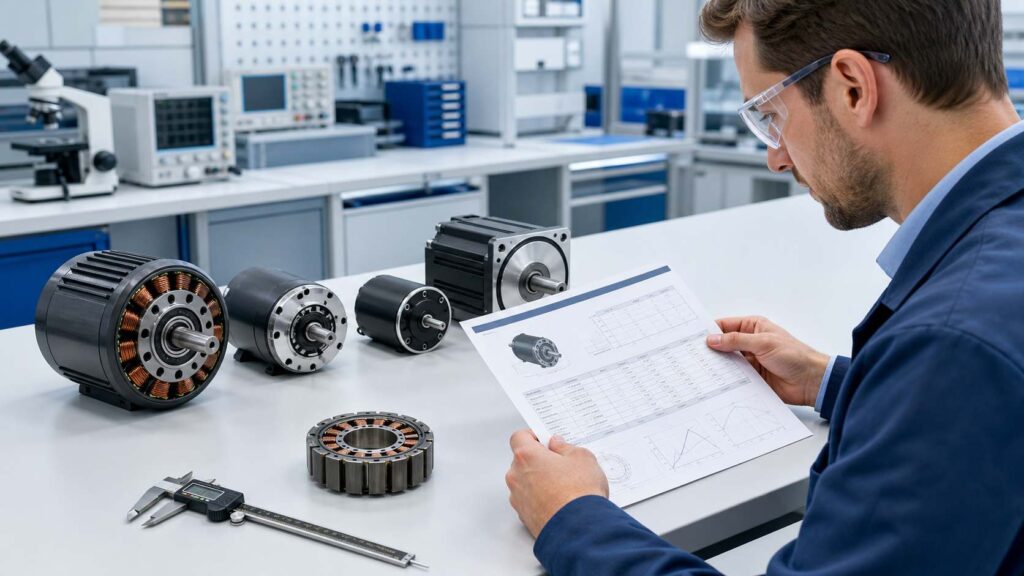
(Illustration: Engineer examining a BLDC motor specification sheet beside several different types of brushless motors.)
Yes.
The term “brushless” means that the motor does not use carbon brushes or a mechanical commutator to switch current.
Instead, current is switched electronically by a motor controller.
Although the motor itself has no brushes, it cannot operate without an electronic controller, which performs the commutation process.
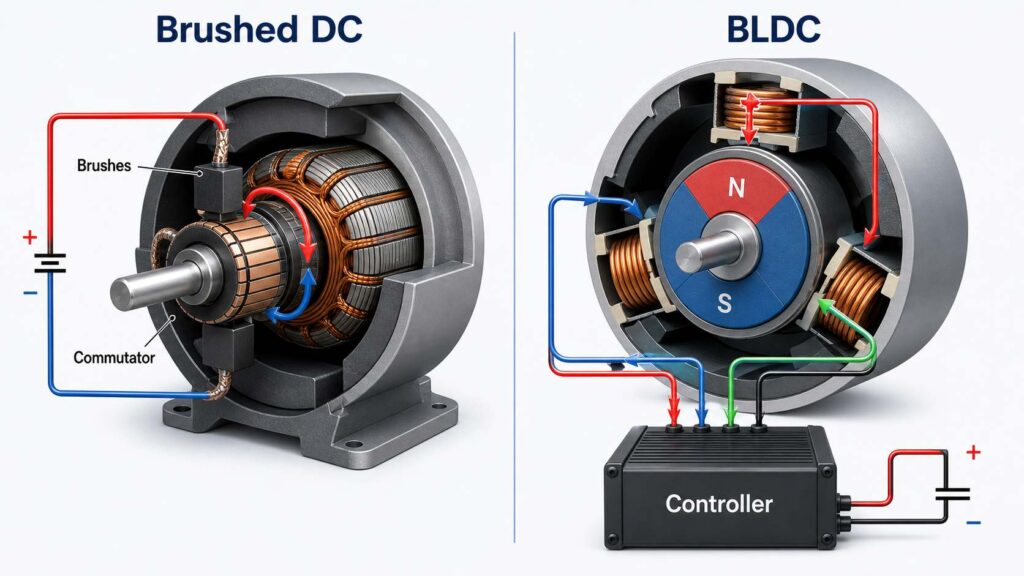
(Illustration: Comparison of the commutation mechanism in a brushed DC motor and a BLDC motor.)
Generally, no.
Connecting a BLDC motor directly to a DC power source will not produce continuous rotation because the motor requires the stator windings to be energized in a controlled sequence.
An electronic speed controller (ESC) or motor driver is required to:
Only complete BLDC drive systems—including both the motor and controller—can operate normally.
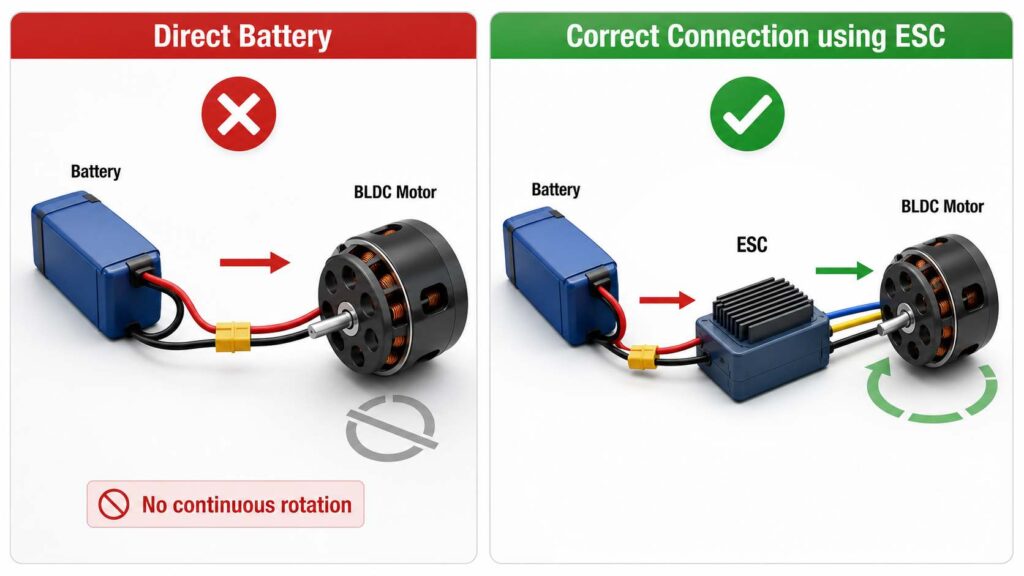
(Illustration: Incorrect direct battery connection compared with the correct connection using an ESC.)
This is one of the most common sources of confusion.
A BLDC motor is powered by a DC power supply, but the controller converts that DC power into a sequence of controlled three-phase currents that energize the stator windings.
For this reason:
This is why BLDC motors share characteristics with both traditional DC motors and permanent magnet synchronous motors.
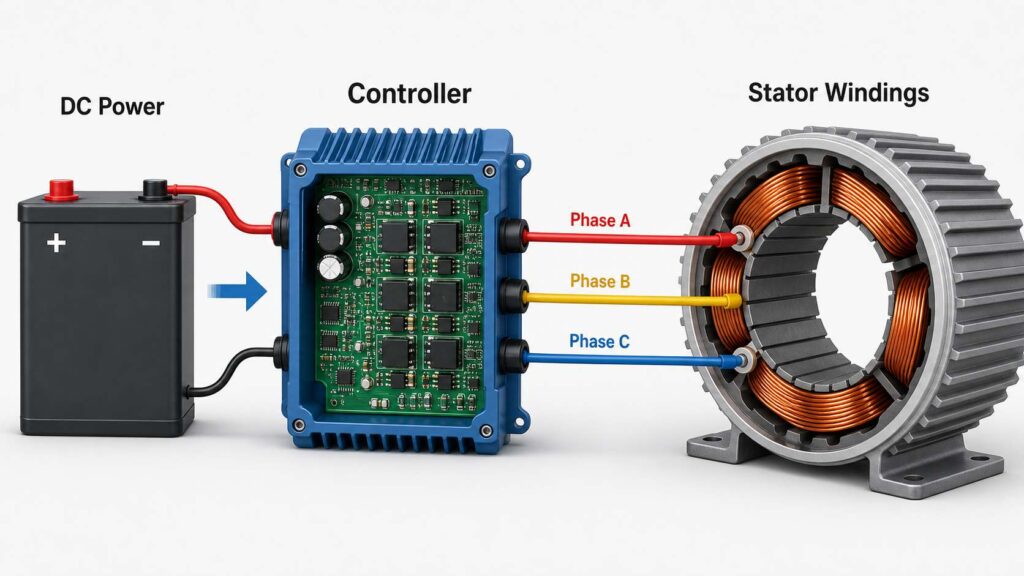
(Illustration: DC power entering the controller and three-phase current flowing to the stator windings.)
Technical Clarification:
Although called a “Brushless DC Motor,” the stator is driven by electronically commutated multi-phase current rather than constant direct current.
These two motor types are closely related and are often confused.
Both use:
The primary difference lies in the shape of the back electromotive force (back EMF) and the control strategy.
| Feature | BLDC Motor | PMSM |
|---|---|---|
| Back EMF | Trapezoidal | Sinusoidal |
| Typical Control | Six-step commutation | Field-Oriented Control (FOC) |
| Typical Applications | Fans, pumps, power tools | Servo systems, precision motion control, EV traction |
In practice, many modern controllers—especially those using FOC—can operate both motor types.
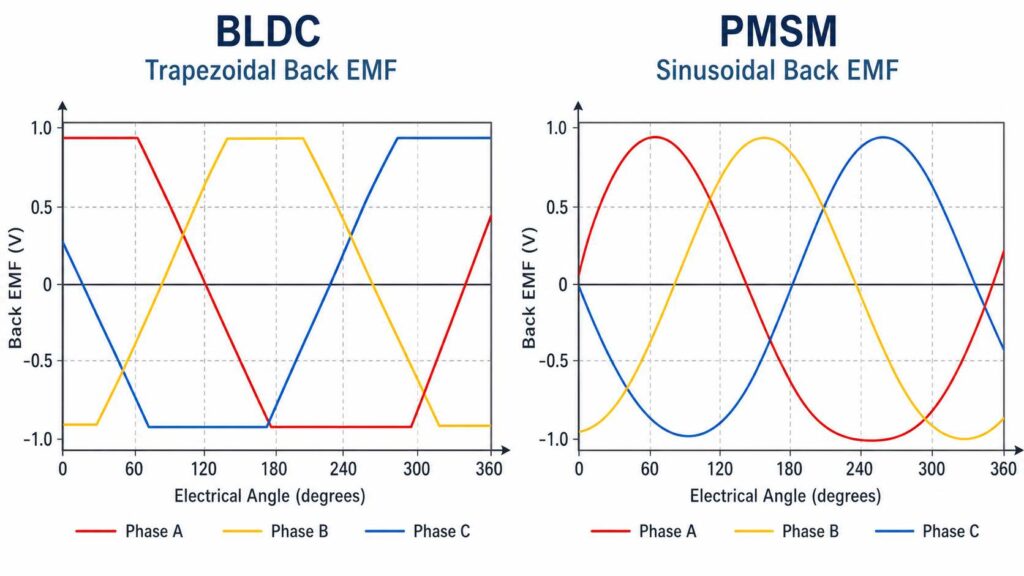
(Illustration: Comparison of trapezoidal and sinusoidal back EMF waveforms.)
Not necessarily.
There are two common types of BLDC motors:
These motors include Hall-effect sensors that directly detect rotor position.
Advantages include:
Sensorless motors estimate rotor position by measuring back EMF.
Advantages include:
Each approach has advantages depending on the application.
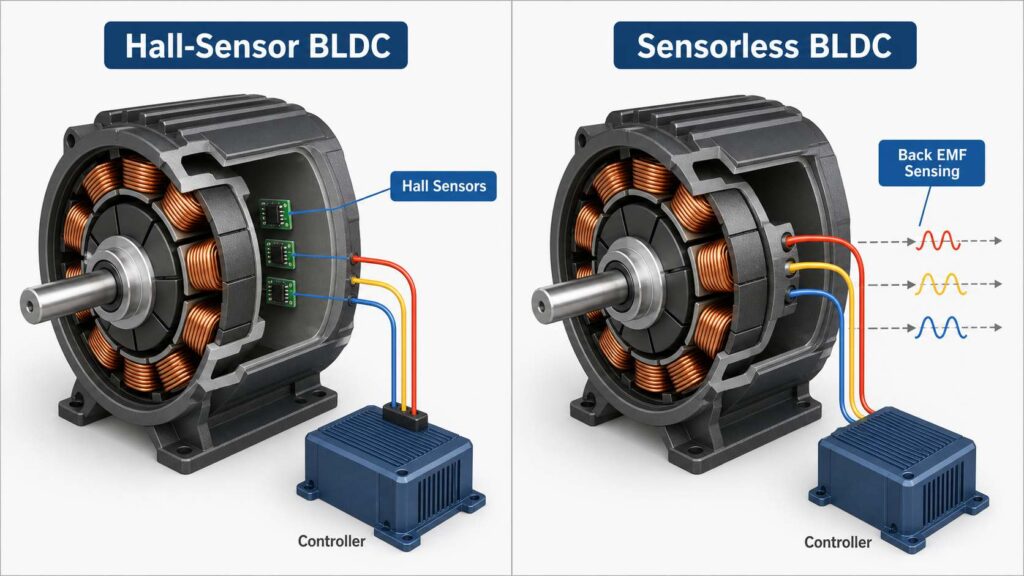
(Illustration: Side-by-side comparison of a Hall-sensor BLDC motor and a sensorless BLDC motor.)
Several factors contribute to their higher efficiency:
However, overall system efficiency also depends on:
A high-quality controller is just as important as the motor itself.
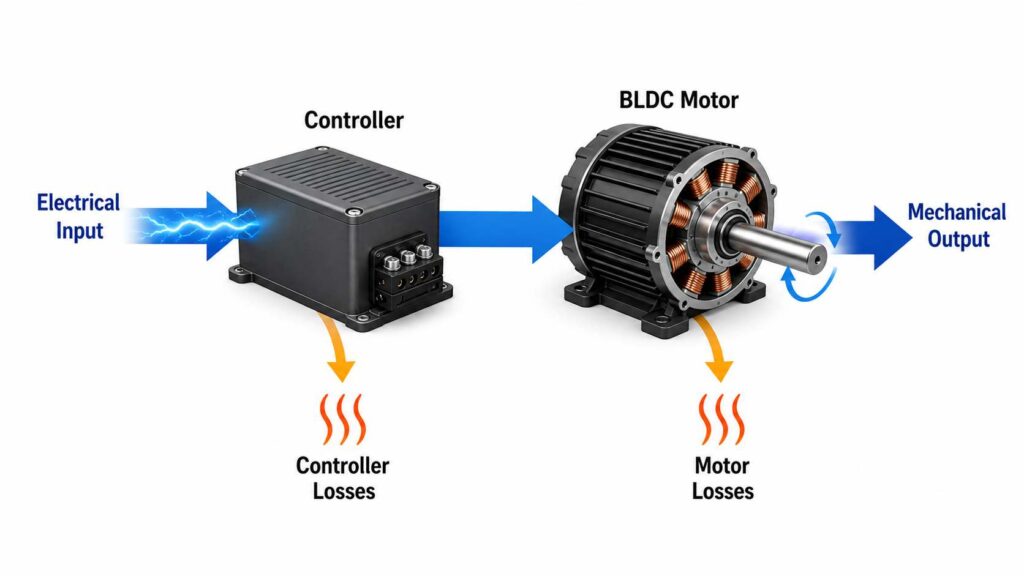
(Illustration: Energy flow diagram showing electrical input, controller losses, motor losses, and mechanical output.)
Compared with brushed DC motors, BLDC systems require additional components and more advanced manufacturing.
Typical cost factors include:
Although the initial purchase price is higher, lower maintenance requirements and improved efficiency often reduce the total cost of ownership over the product’s lifetime.
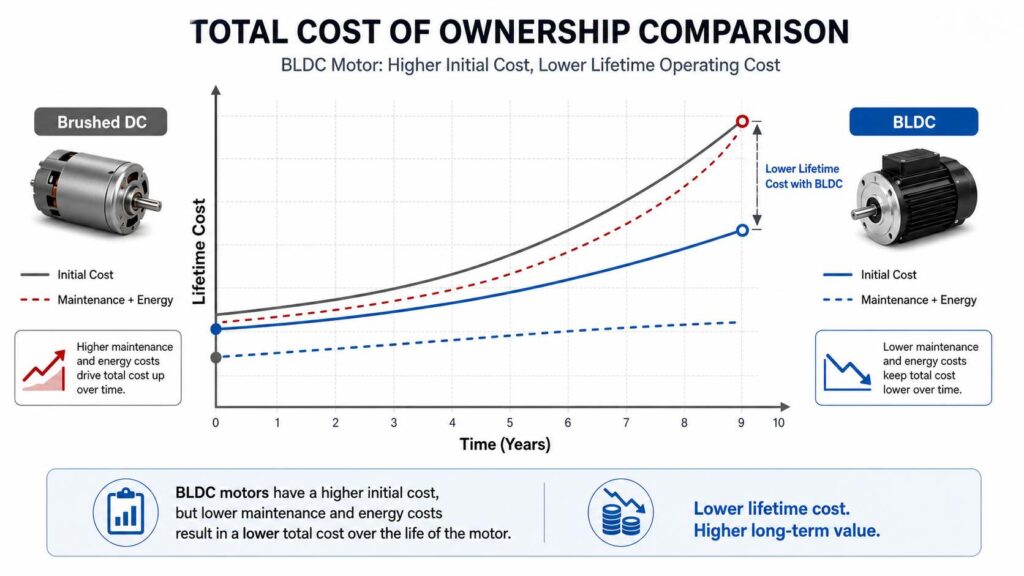
(Illustration: Cost comparison showing higher initial cost but lower lifetime operating cost for a BLDC motor.)
Selecting a motor should begin with the application’s requirements rather than the motor itself.
Typical selection factors include:
Avoid selecting a motor based on only one specification, such as KV or maximum speed.
A balanced evaluation of all operating requirements will generally lead to the best solution.
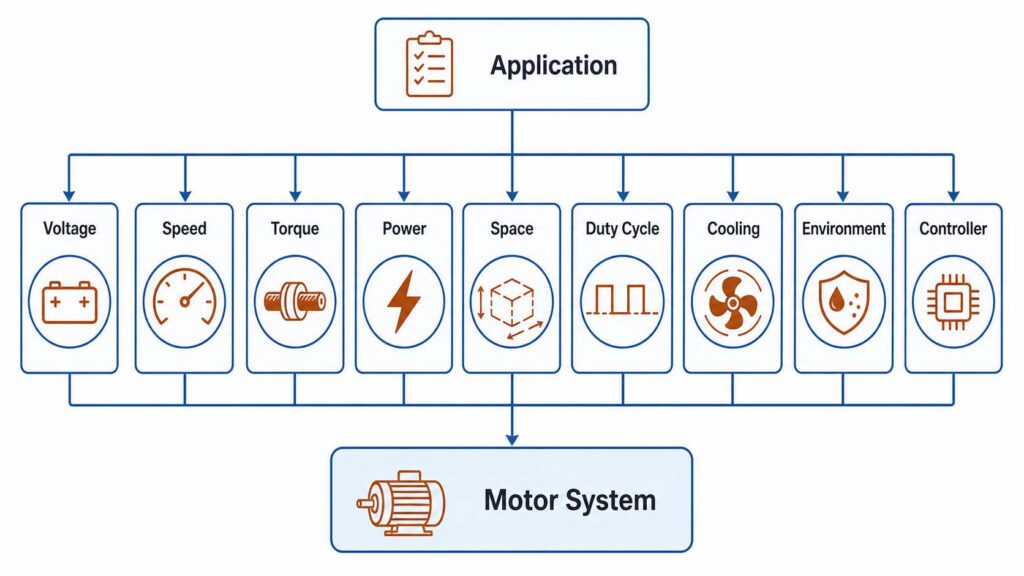
(Illustration: Motor selection flowchart showing the major specification parameters considered during the selection process.)
Brushless DC motors have transformed modern motion-control technology by combining high efficiency, long service life, precise electronic control, and compact design.
From consumer electronics and industrial automation to robotics, medical devices, and electric transportation, BLDC motors continue to replace traditional brushed motors in an expanding range of applications.
Understanding their construction, operating principles, key performance parameters, and control methods provides a solid foundation for selecting the right motor and designing reliable drive systems.
As motor technology and electronic control continue to advance, BLDC motors are expected to play an even greater role in the next generation of intelligent equipment and energy-efficient systems.
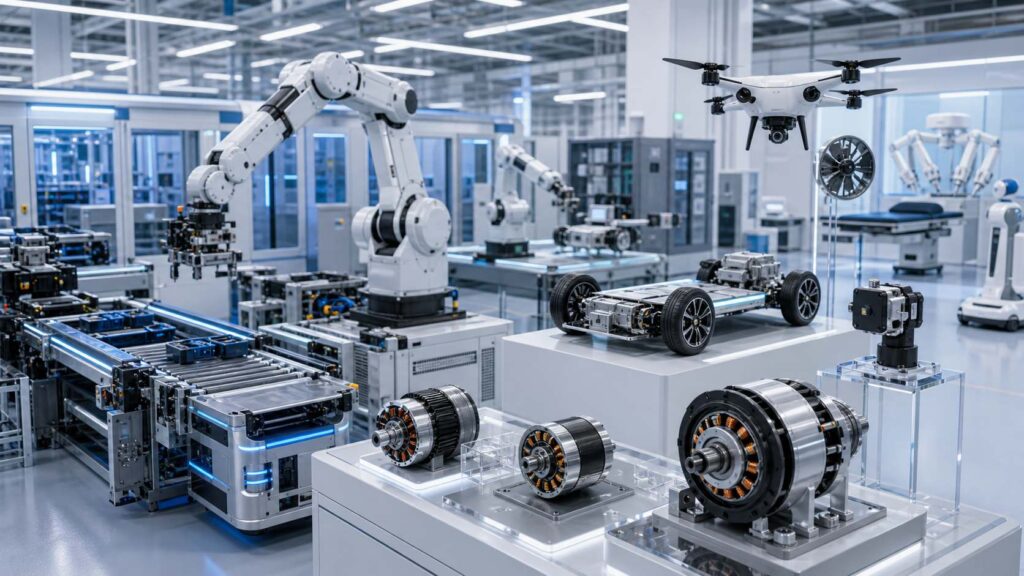
(Illustration: A modern manufacturing environment showcasing the wide range of BLDC motor applications, symbolizing the future of intelligent motion control.)