Our Location
304 North Cardinal St.
Dorchester Center, MA 02124

304 North Cardinal St.
Dorchester Center, MA 02124
After understanding the construction, operating principles, and control methods of BLDC motors, it becomes easier to understand why they have become the preferred choice in so many modern applications. Compared with traditional brushed DC motors, BLDC motors offer significant improvements in efficiency, reliability, controllability, and service life.
At the same time, they also have certain limitations that should be considered during motor selection.
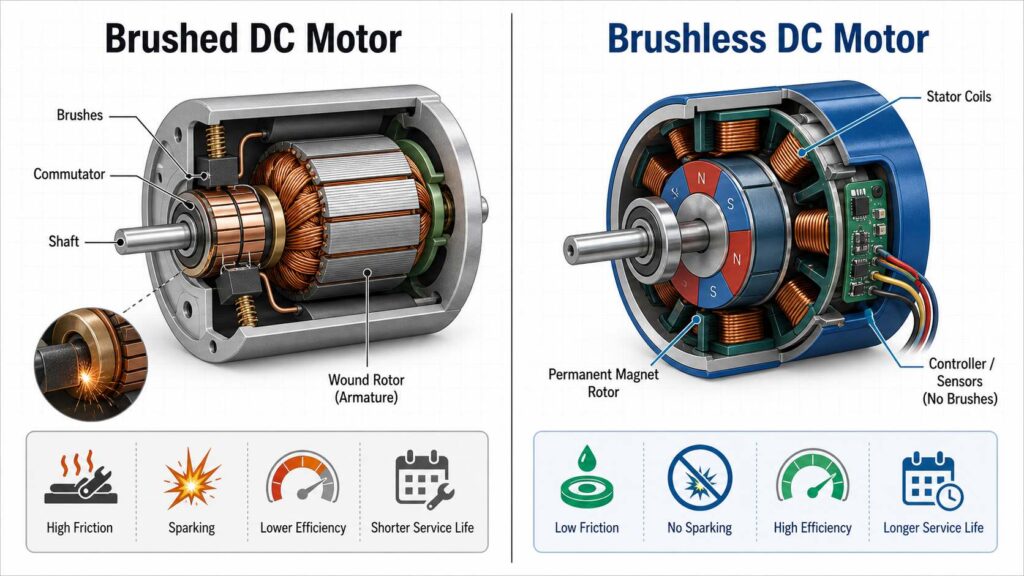
(Illustration: Side-by-side comparison of a brushed DC motor and a brushless DC motor, highlighting their key differences in construction and performance.)
One of the greatest advantages of a BLDC motor is its high efficiency.
In a brushed motor, electrical energy is lost through:
Since a BLDC motor eliminates the brush and commutator assembly, these losses are greatly reduced.
As a result, more electrical energy is converted into useful mechanical output.
Higher efficiency provides several practical benefits:
This is one of the primary reasons why BLDC motors are widely used in battery-powered equipment.
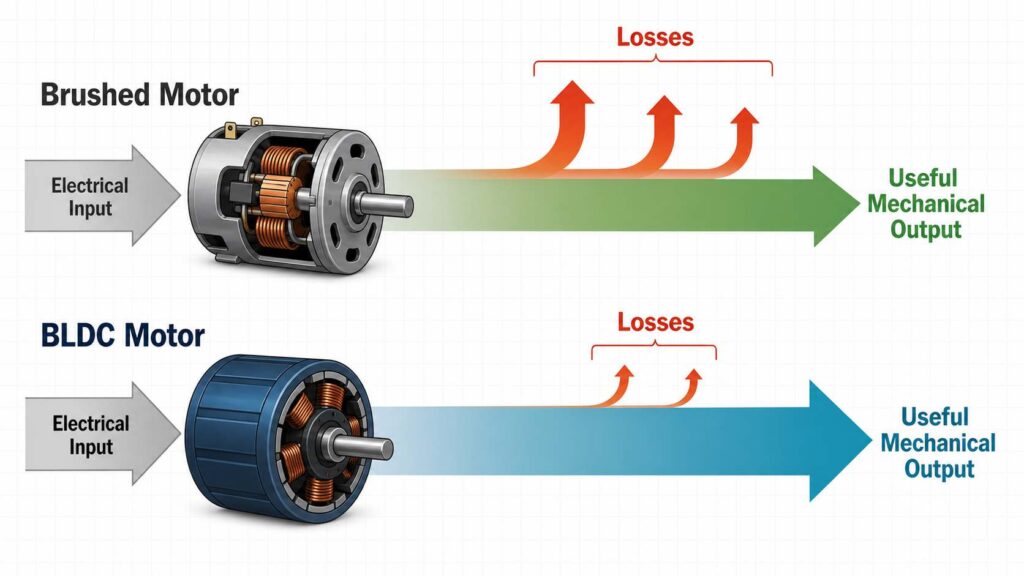
(Illustration: Energy flow diagram comparing power losses in brushed and brushless motors.)
Brushes are consumable components.
In a conventional brushed motor, the brushes gradually wear during operation and eventually require replacement.
Since a BLDC motor has no brushes, there is no brush wear.
The remaining mechanical wear is mainly limited to components such as:
With proper operating conditions and maintenance, a BLDC motor can achieve a significantly longer service life than an equivalent brushed motor.
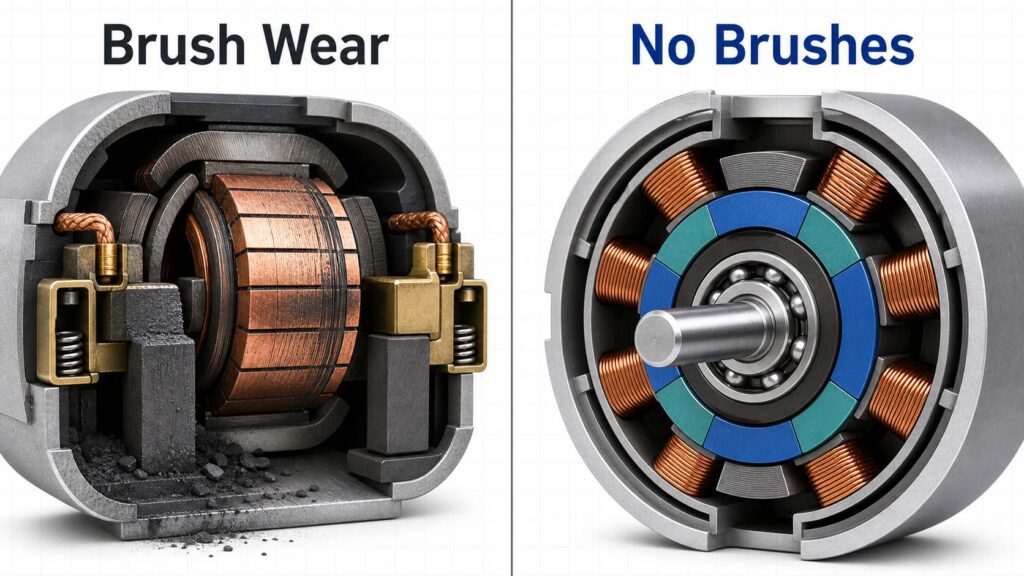
(Illustration: Comparison showing brush wear in a brushed motor versus the brushless construction of a BLDC motor.)
Because there are no brushes or commutators to inspect, clean, or replace, BLDC motors require considerably less routine maintenance.
This makes them especially suitable for applications where maintenance is difficult or expensive, such as:
Lower maintenance requirements also reduce system downtime and overall operating costs.
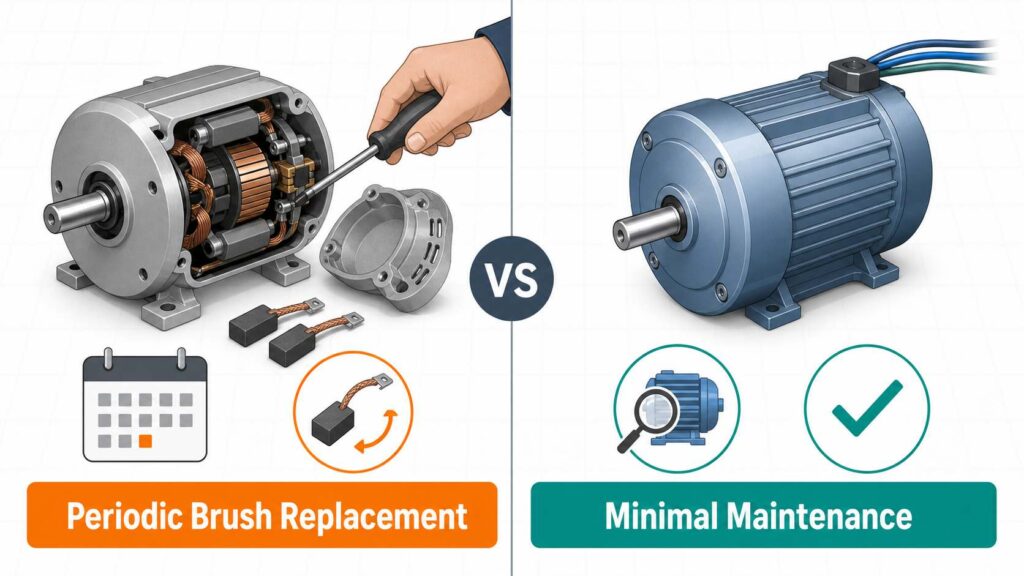
(Illustration: Maintenance comparison showing periodic brush replacement for a brushed motor and minimal maintenance for a BLDC motor.)
Mechanical brush contact produces both audible noise and electrical arcing.
Electrical arcing may generate electromagnetic interference (EMI), which can affect nearby electronic equipment.
Because BLDC motors use electronic commutation instead of mechanical commutation:
These characteristics make BLDC motors suitable for equipment requiring quiet operation or sensitive electronic environments.
Typical examples include:
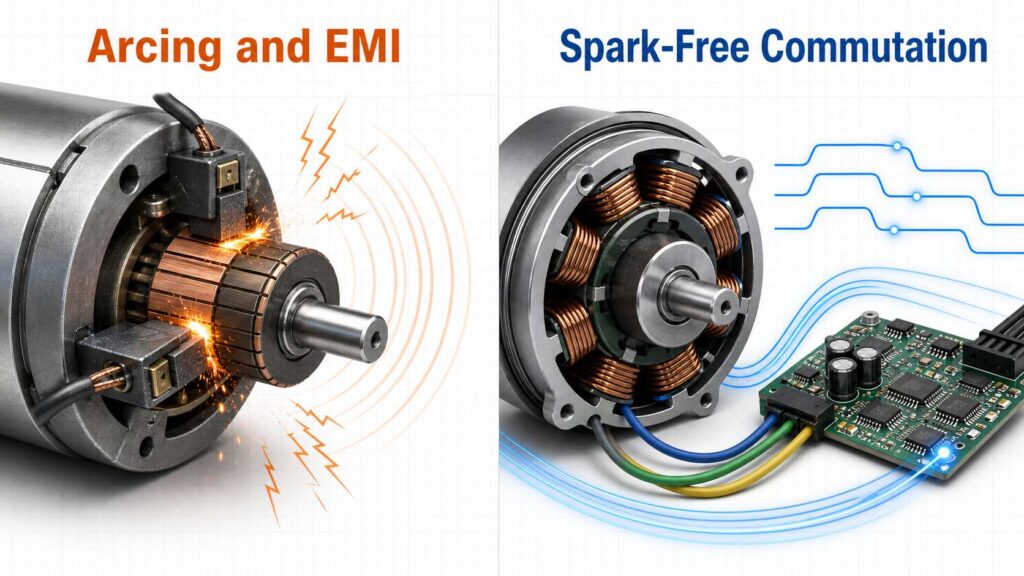
(Illustration: Comparison of electrical arcing in a brushed motor and spark-free electronic commutation in a BLDC motor.)
The speed of a BLDC motor is controlled electronically rather than mechanically.
Modern motor controllers can regulate speed with high precision over a wide operating range.
Compared with brushed motors, BLDC motors generally offer:
These characteristics make BLDC motors particularly suitable for automation and motion-control applications.
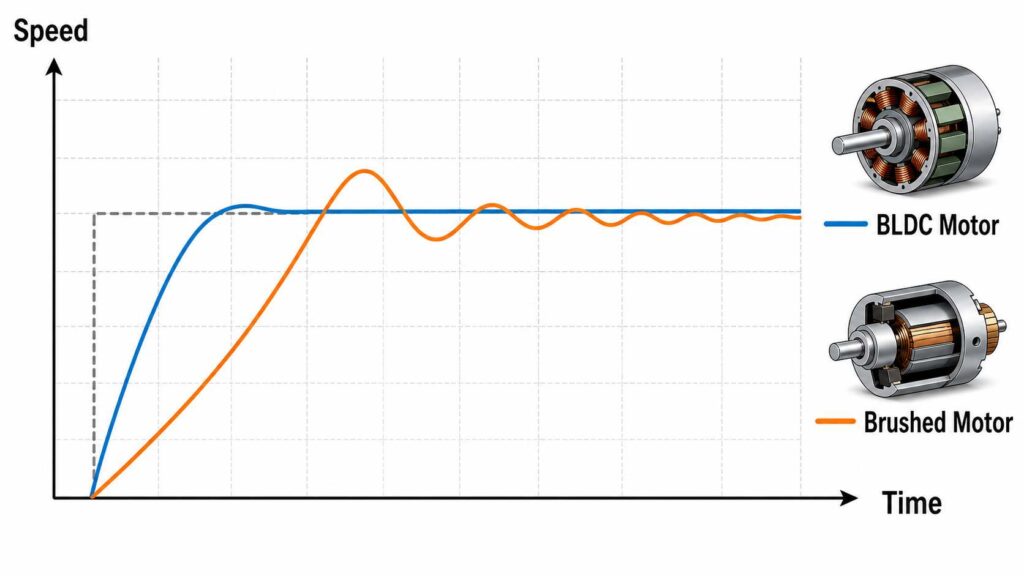
(Illustration: Speed-response graph comparing the control performance of brushed and brushless motors.)
BLDC motors can deliver relatively high output power from a compact package.
This high power density results from several factors:
As a result, many portable and space-constrained products can achieve excellent performance without increasing overall size or weight.
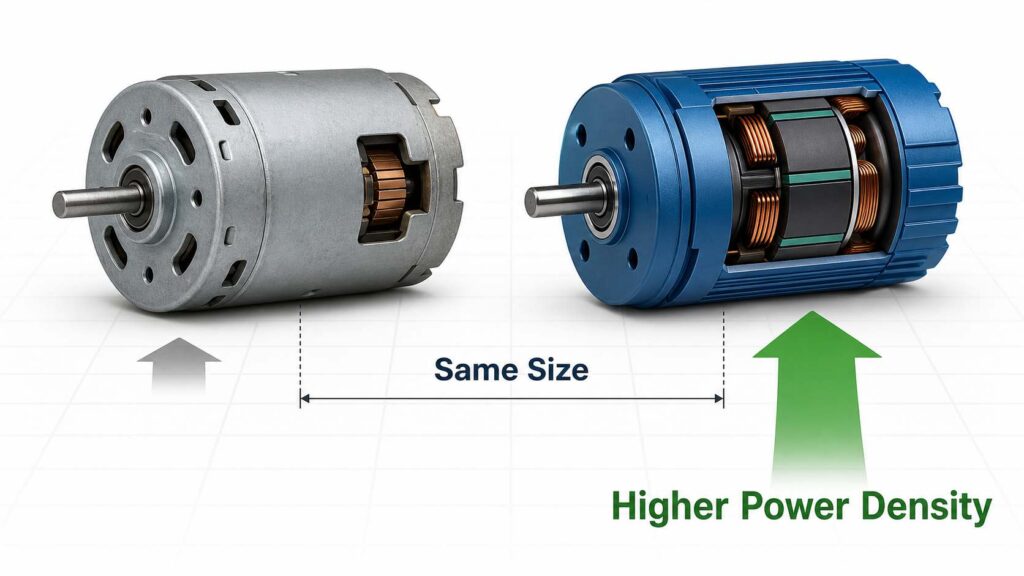
(Illustration: Comparison of two motors with similar physical dimensions but different power densities.)
Without brushes and a mechanical commutator, BLDC motors are capable of operating at much higher rotational speeds.
The maximum speed depends on factors such as:
Many industrial BLDC motors operate at tens of thousands of revolutions per minute, while specialized designs can reach even higher speeds.
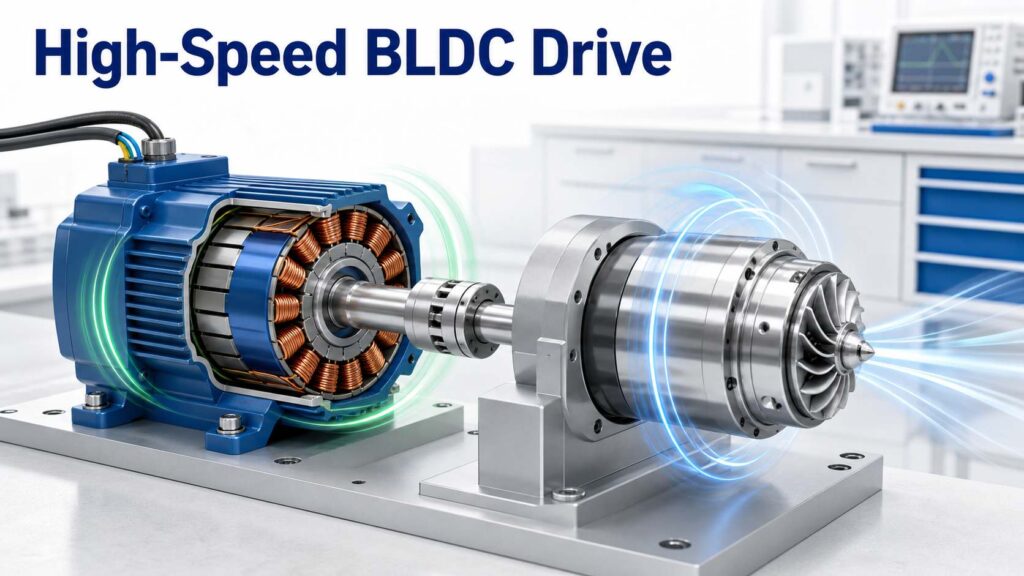
(Illustration: High-speed BLDC motor driving a turbine or precision spindle.)
Although BLDC motors offer many advantages, they are not the ideal solution for every application.
The primary limitations include:
BLDC motors generally cost more than brushed motors because they require:
However, in many applications, the higher initial cost is offset by lower maintenance and operating expenses over the motor’s lifetime.
A brushed motor can often operate directly from a DC power source.
A BLDC motor requires an appropriate controller capable of performing electronic commutation.
This increases overall system complexity and requires proper controller selection.
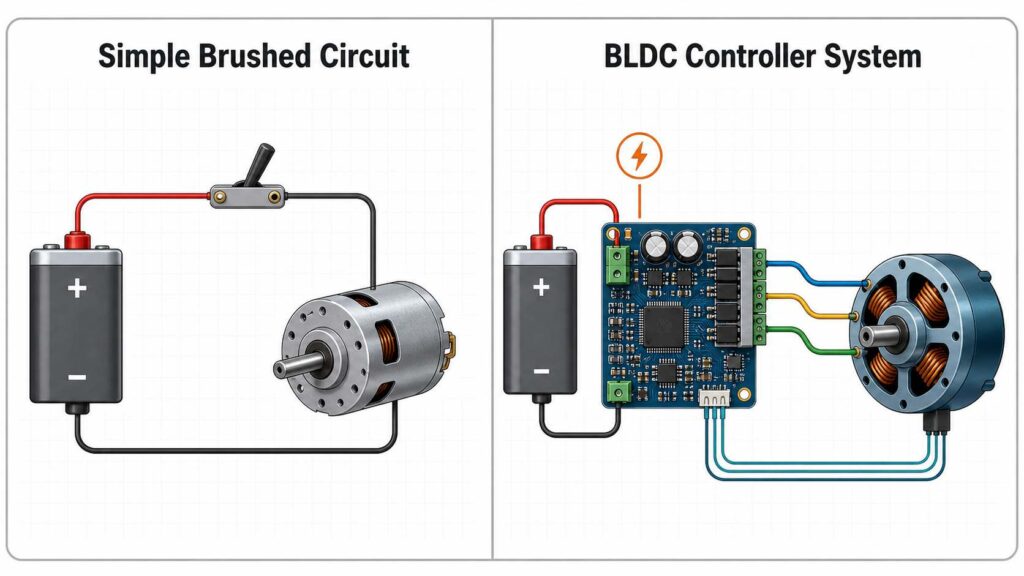
(Illustration: Comparison of a simple brushed motor circuit and a BLDC motor system with an electronic controller.)
Motor performance depends not only on the motor itself but also on:
For demanding applications, careful integration and tuning may be necessary to achieve the desired performance.
Neither motor type is universally better.
The appropriate choice depends on the application’s requirements.
A brushed DC motor may be preferred when:
A BLDC motor is generally preferred when:
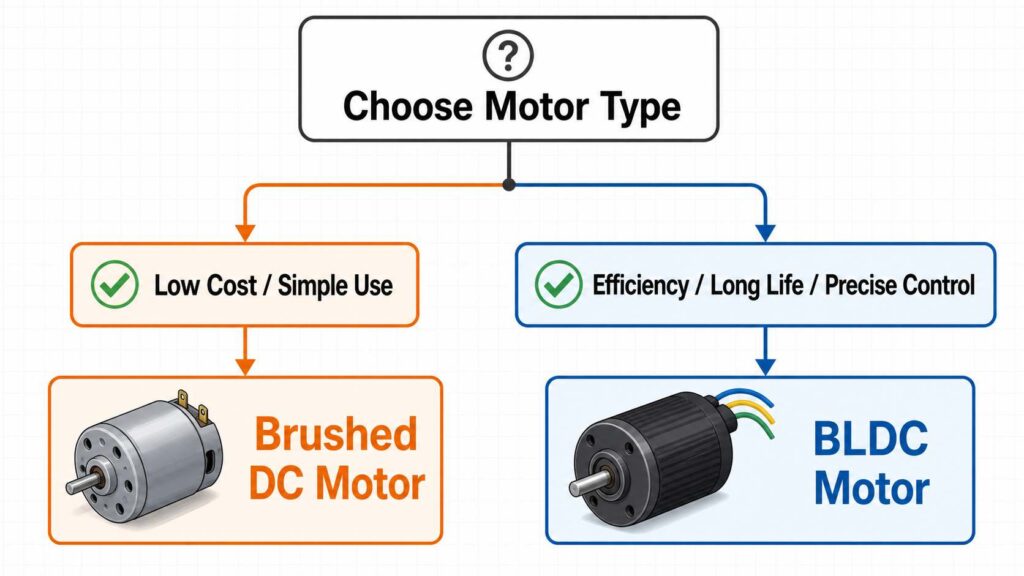
(Illustration: Decision flowchart helping users choose between brushed and brushless DC motors based on application requirements.)