Our Location
304 North Cardinal St.
Dorchester Center, MA 02124

304 North Cardinal St.
Dorchester Center, MA 02124
Electric motors are used in countless devices, from household appliances and automotive systems to industrial equipment and medical devices. Among the many types of electric motors, the Brushed DC (BDC) motor remains one of the most widely used due to its simple construction, low cost, and ease of control.
Although Brushless DC (BLDC) motors have gained popularity in recent years, brushed DC motors continue to play an important role in applications where affordability, straightforward control, and reliable operation are more important than maximum efficiency or long service life.
This guide provides a comprehensive introduction to brushed DC motors, including their construction, working principles, performance characteristics, selection methods, applications, and maintenance.
Whether you are an engineer, purchaser, student, or product designer, this guide will help you understand how brushed DC motors work and how to choose the right motor for your application.
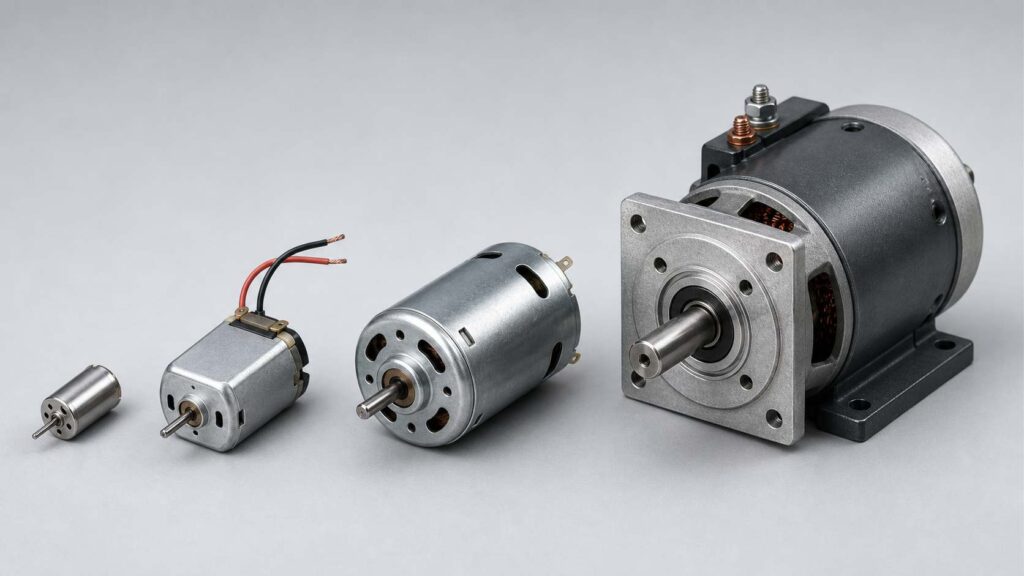
(Illustration: A collection of brushed DC motors in different sizes, from miniature motors used in toys to larger industrial DC motors.)
A Brushed DC motor is an electric motor that converts direct current (DC) electrical energy into mechanical rotational motion through mechanical commutation.
Unlike brushless motors, which rely on electronic controllers to switch current between motor windings, a brushed DC motor uses carbon brushes and a mechanical commutator to automatically reverse the direction of current as the rotor turns.
This mechanical switching process keeps the rotor rotating continuously in the same direction.
Because of its simple operating principle, a brushed DC motor can often be powered directly from a DC power supply without requiring a dedicated electronic motor controller.
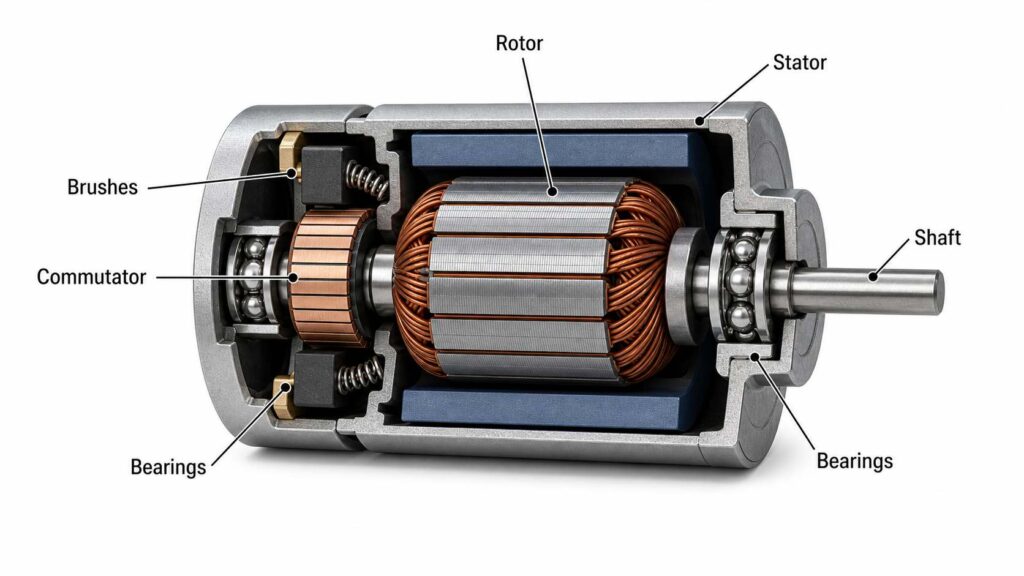
(Illustration: Cross-sectional diagram of a brushed DC motor showing the rotor, stator, brushes, commutator, shaft, and bearings.)
The name “Brushed DC motor” comes from one of its defining components—the brushes.
In modern motors, these brushes are typically made from carbon or graphite rather than metal wire.
The brushes remain in continuous contact with the rotating commutator, allowing electrical current to flow into the rotor windings.
As the rotor rotates, the commutator automatically changes the current path, producing continuous torque and rotation.
Because the brushes are in constant mechanical contact with the commutator, they gradually wear over time and must eventually be replaced.
This brush wear is one of the main differences between brushed and brushless motor technologies.
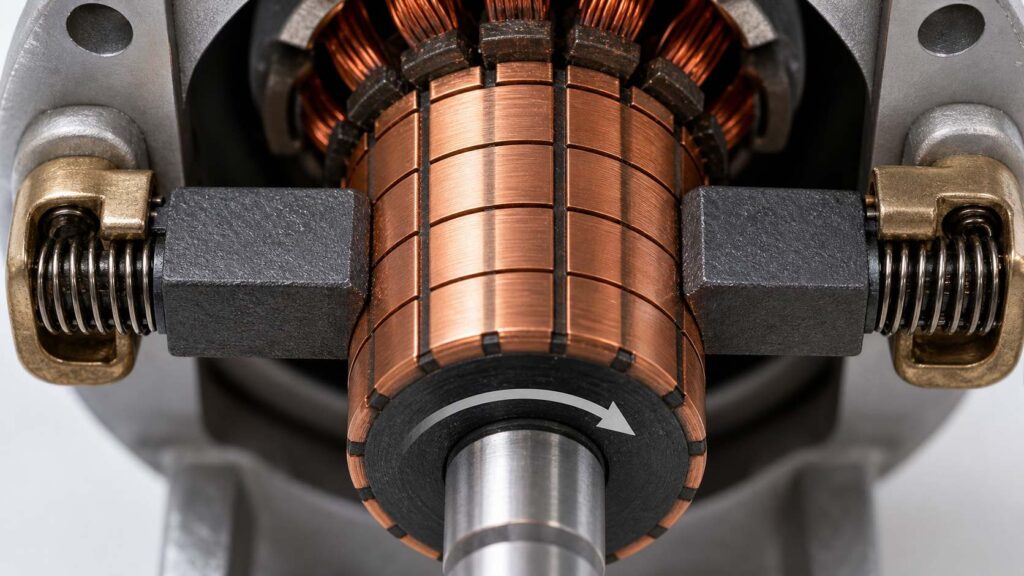
(Illustration: Close-up illustration showing carbon brushes contacting the commutator during motor operation.)
Both brushed and brushless DC motors convert electrical energy into rotational motion, but they achieve this in different ways.
The most important difference lies in the commutation method.
| Feature | Brushed DC Motor | Brushless DC Motor |
|---|---|---|
| Commutation | Mechanical (Brushes & Commutator) | Electronic (Motor Controller) |
| Brushes | Required | Not Required |
| Controller | Usually not required for basic operation | Required |
| Maintenance | Periodic brush replacement | Minimal |
| Efficiency | Moderate | High |
| Initial Cost | Lower | Higher |
| Service Life | Shorter | Longer |
Rather than viewing one technology as universally superior, it is more accurate to say that each motor type is optimized for different applications.
Brushed DC motors remain an excellent choice for many cost-sensitive and low-complexity systems.
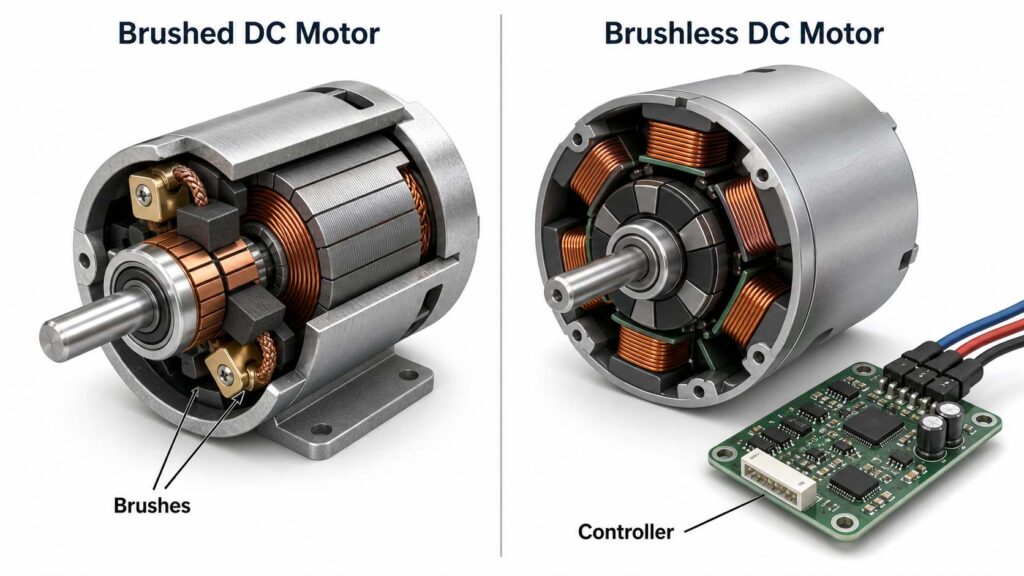
(Illustration: Side-by-side comparison of a brushed DC motor and a brushless DC motor, highlighting the brushes and electronic controller.)
Brushed DC motors are known for several practical advantages that have made them popular for decades.
Typical characteristics include:
However, because they rely on mechanical brushes, they also experience:
These characteristics make brushed DC motors particularly suitable for applications where simplicity and low cost are more important than maintenance-free operation.
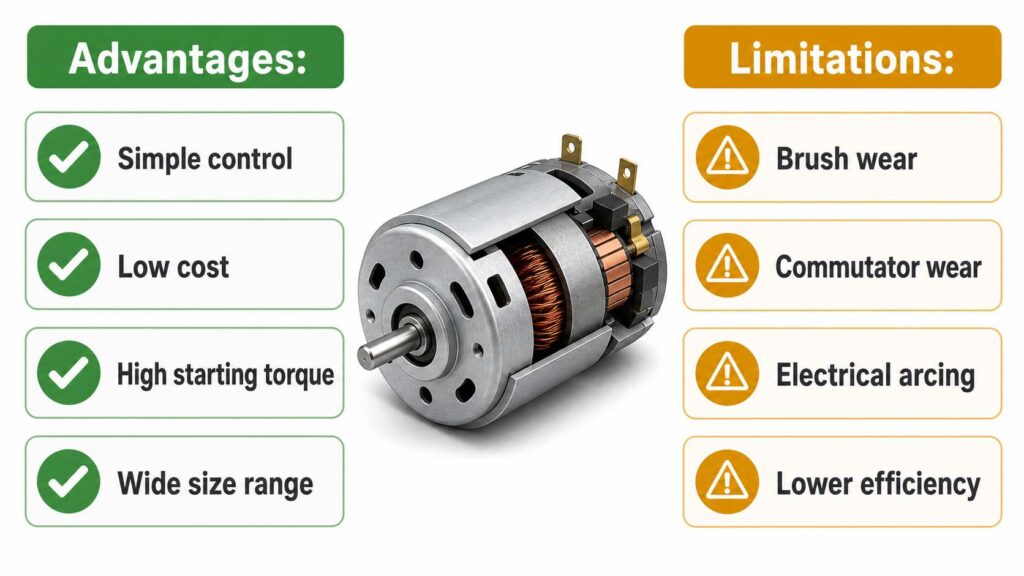
(Illustration: Infographic summarizing the main advantages and limitations of brushed DC motors.)
Brushed DC motors continue to be widely used in both consumer and industrial products.
Typical applications include:
In many of these applications, the motor operates intermittently, making brush wear less significant over the product’s lifetime.
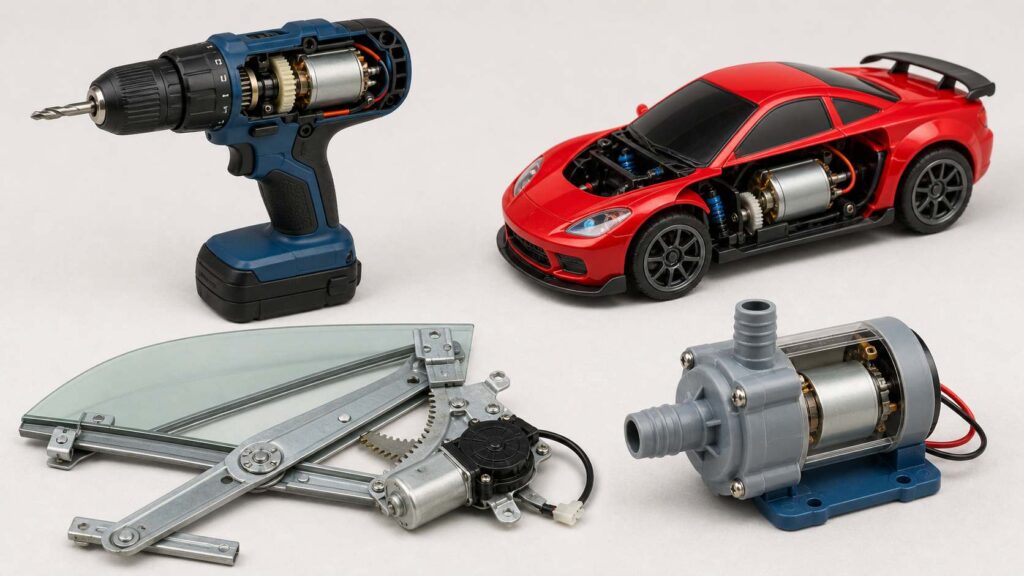
(Illustration: Various products using brushed DC motors, including a cordless drill, toy car, automotive power window, and small water pump.)
Although brushless technology has expanded rapidly, brushed DC motors continue to be manufactured in large quantities around the world.
Several factors contribute to their continued popularity:
For many products, these practical advantages outweigh the benefits offered by more advanced motor technologies.
As a result, brushed DC motors remain an important solution in industries where cost, simplicity, and ease of implementation are key design priorities.
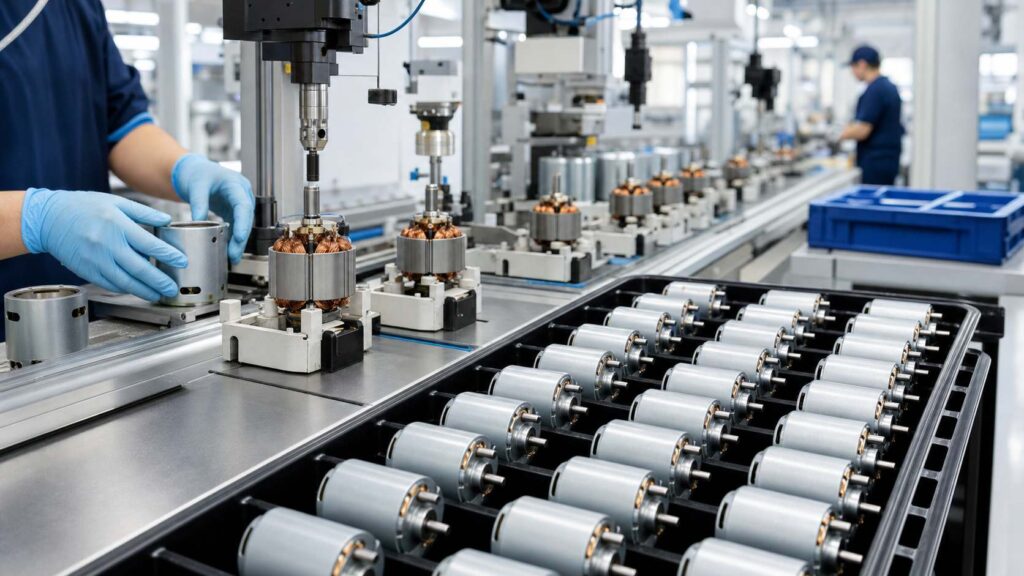
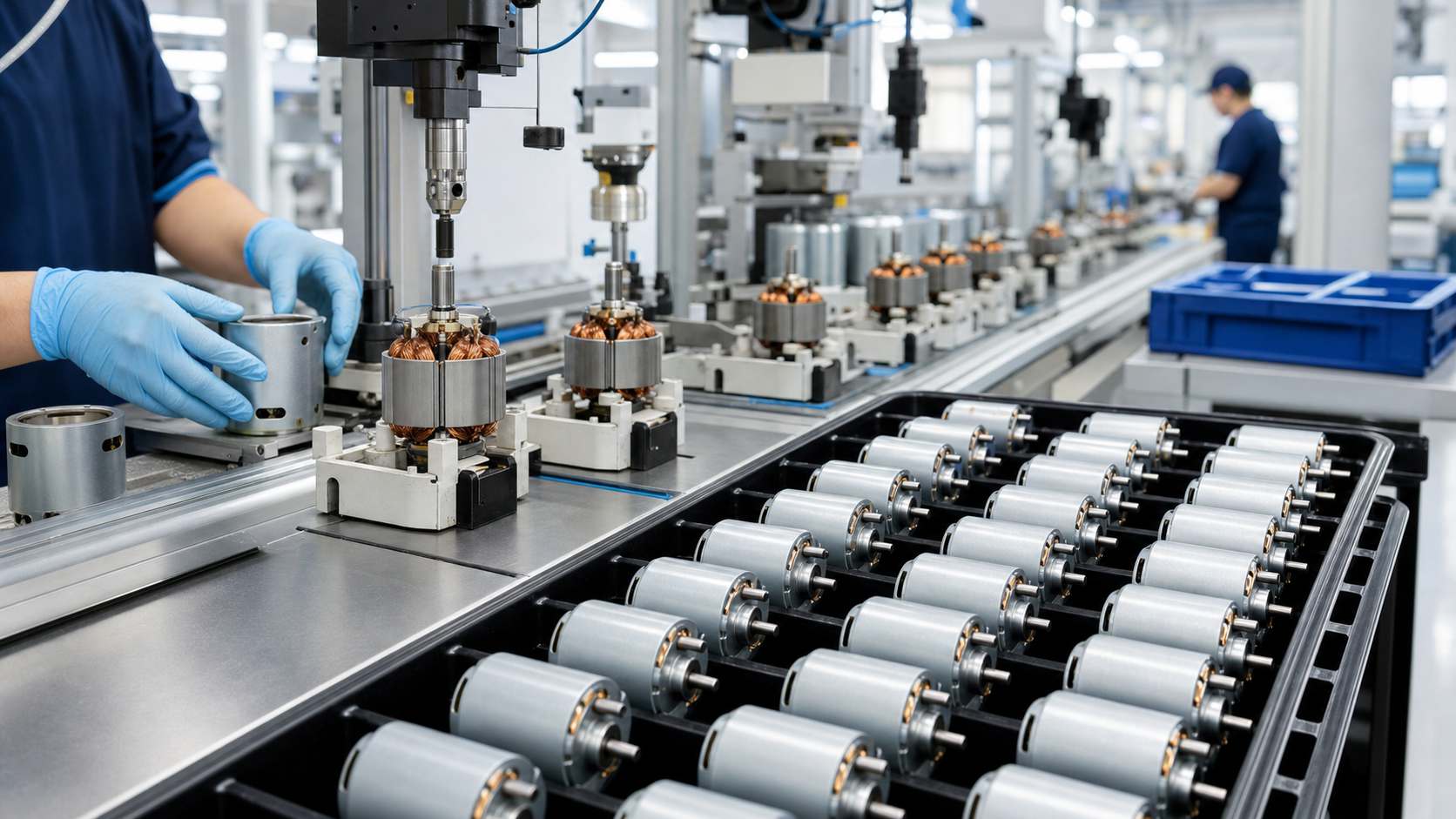
(Illustration: Factory assembly line producing brushed DC motors alongside finished motors ready for shipment.)
A common misconception is that brushed DC motors are “obsolete” because brushless motors are becoming more common.
In reality, both technologies continue to coexist because they address different engineering requirements.
Brushed DC motors remain highly competitive in applications that require:
For these reasons, millions of brushed DC motors are still produced every year for industrial, automotive, medical, and consumer applications.