Our Location
304 North Cardinal St.
Dorchester Center, MA 02124

304 North Cardinal St.
Dorchester Center, MA 02124
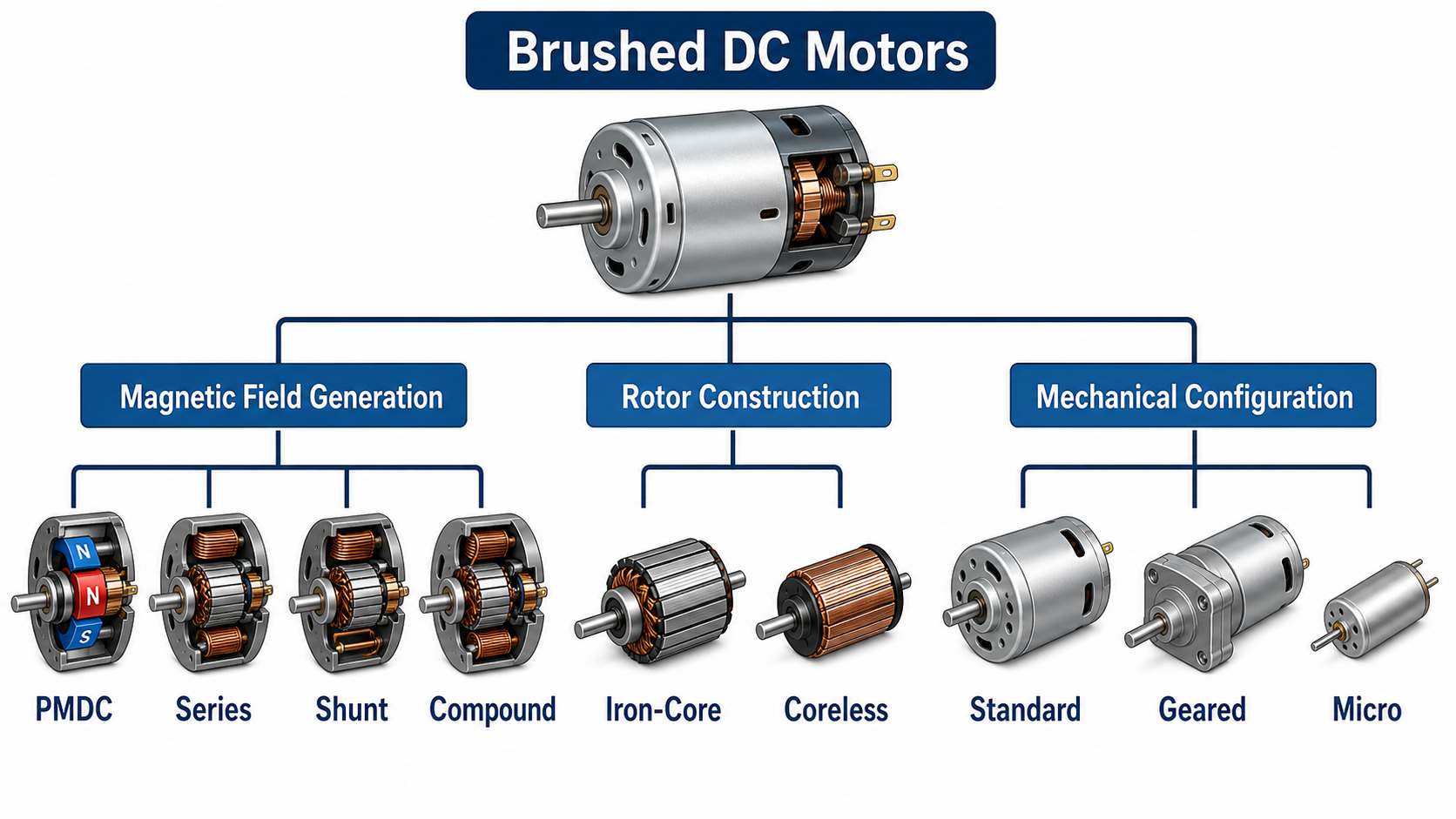
Not all brushed DC motors are the same.
Although they all use carbon brushes and a mechanical commutator to switch current, brushed DC motors can be classified in several different ways based on their magnetic field design, armature construction, or intended application.
Understanding these motor types helps engineers and buyers select the most suitable motor for specific performance requirements such as torque, speed, efficiency, size, or cost.
This chapter introduces the major types of brushed DC motors and explains the characteristics, advantages, and typical applications of each.
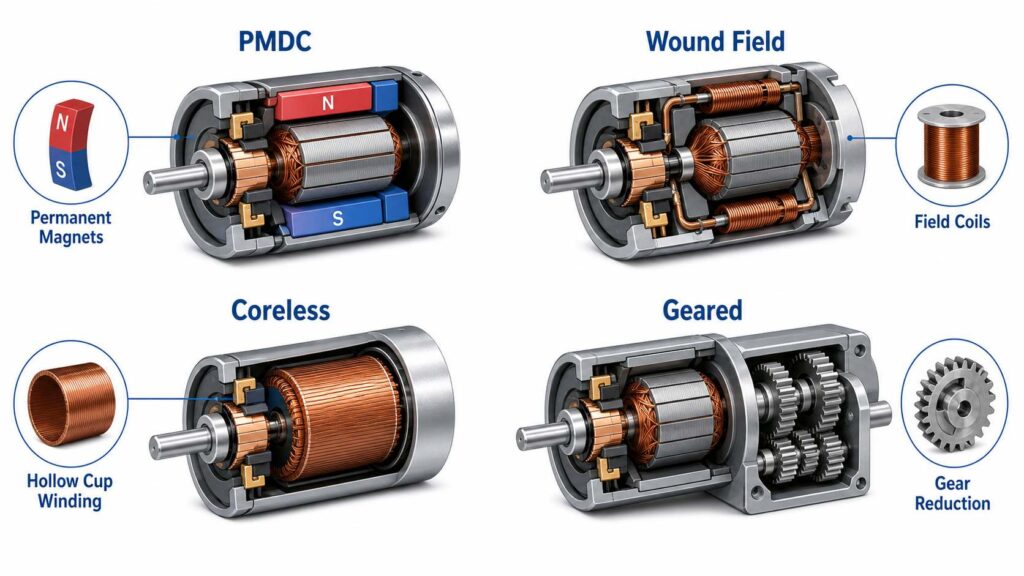
(Illustration: A comparison of different brushed DC motor types, including permanent magnet, wound-field, coreless, and geared brushed motors.)
Brushed DC motors can generally be classified from three perspectives:
Each classification serves a different engineering purpose.
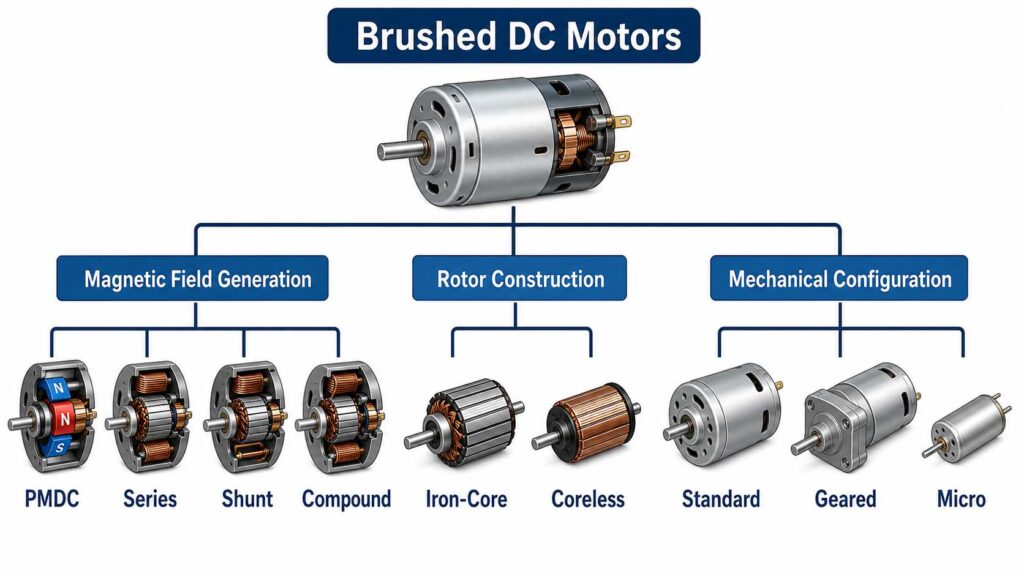
(Illustration: Classification tree showing the three major categories of brushed DC motors.)
This is the most common method used in engineering.
Brushed DC motors can be divided into:
Permanent Magnet DC Motors use permanent magnets mounted inside the stator to generate the magnetic field.
Instead of energizing field windings, the magnets provide a constant magnetic flux.
Today, PMDC motors are the most common type of brushed DC motor found in commercial products.
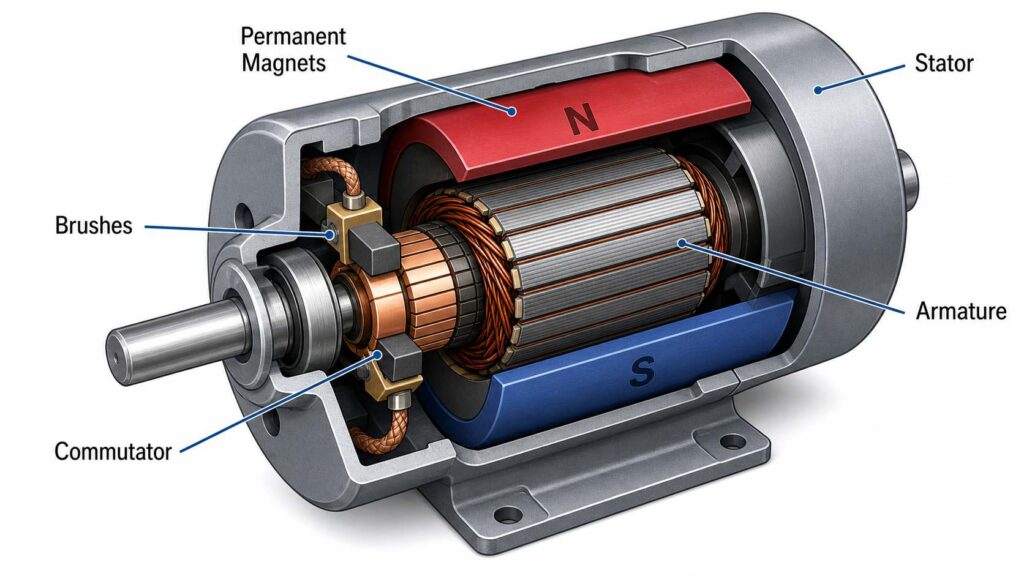
(Illustration: Cross-sectional view of a PMDC motor showing permanent magnets attached to the stator.)
In a series wound motor, the field winding is connected in series with the armature winding.
The same current flows through both.
Because of their excellent starting torque, series motors are widely used where heavy loads must be accelerated from rest.
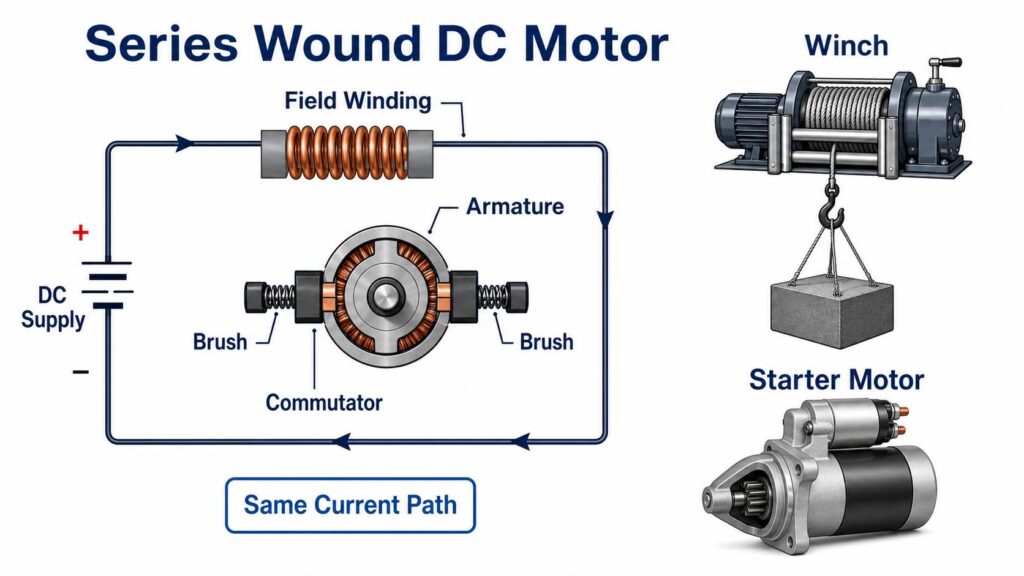
(Illustration: Wiring diagram of a series wound DC motor and examples such as an electric winch or starter motor.)
In a shunt wound motor, the field winding is connected in parallel with the armature.
This arrangement provides a relatively constant magnetic field.
These motors are often selected where maintaining a constant speed is more important than achieving maximum starting torque.
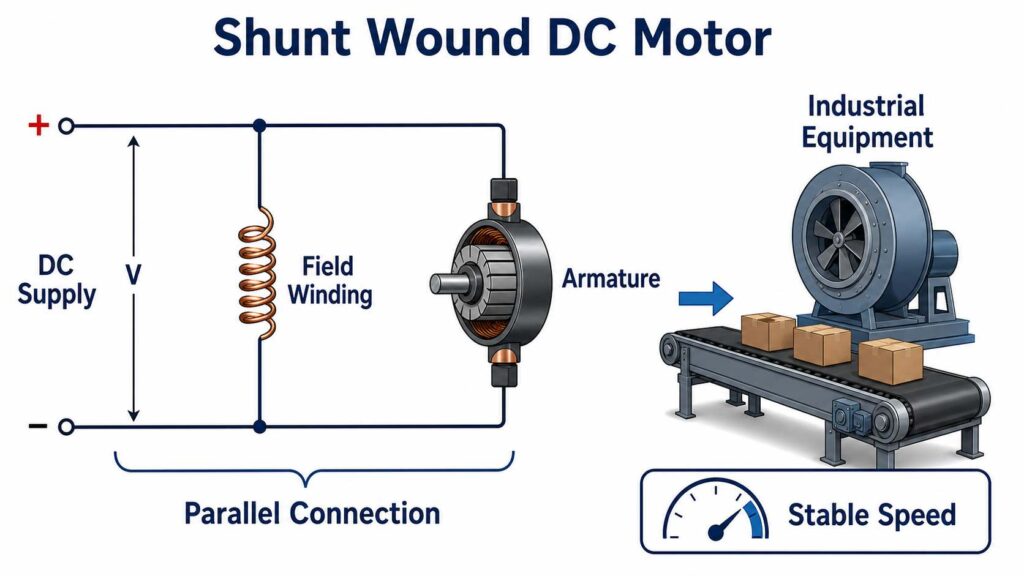
(Illustration: Wiring diagram of a shunt wound DC motor powering industrial equipment.)
Compound wound motors combine both series and shunt field windings.
This design aims to balance the advantages of both motor types.
Although less common in modern commercial products, compound wound motors are still used in specialized industrial systems.
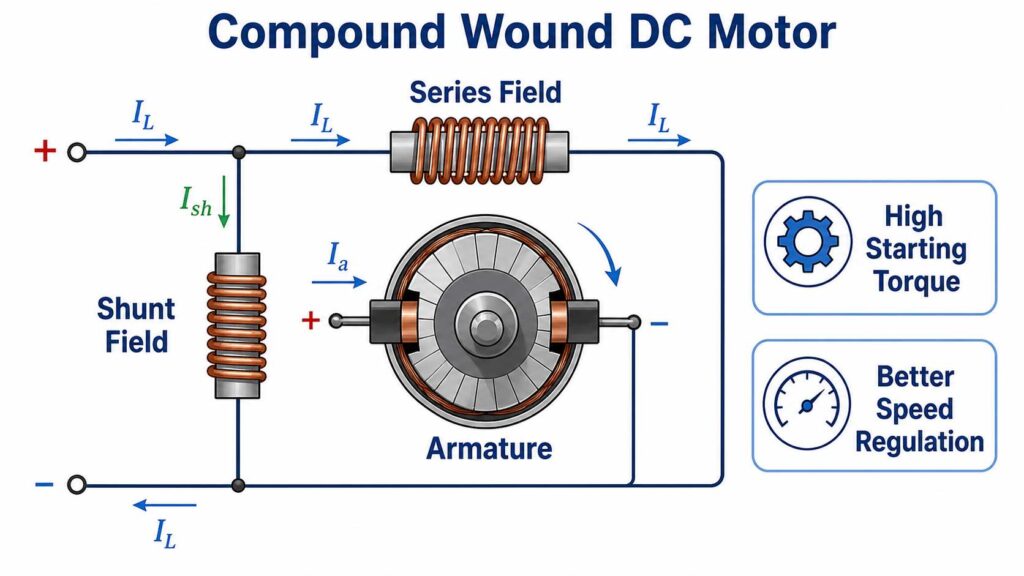
(Illustration: Diagram showing both series and shunt field windings in a compound wound DC motor.)
Another important classification is based on the rotor design.
Traditional brushed DC motors use a laminated iron core to support the armature windings.
These motors remain the standard choice for most industrial and commercial applications.
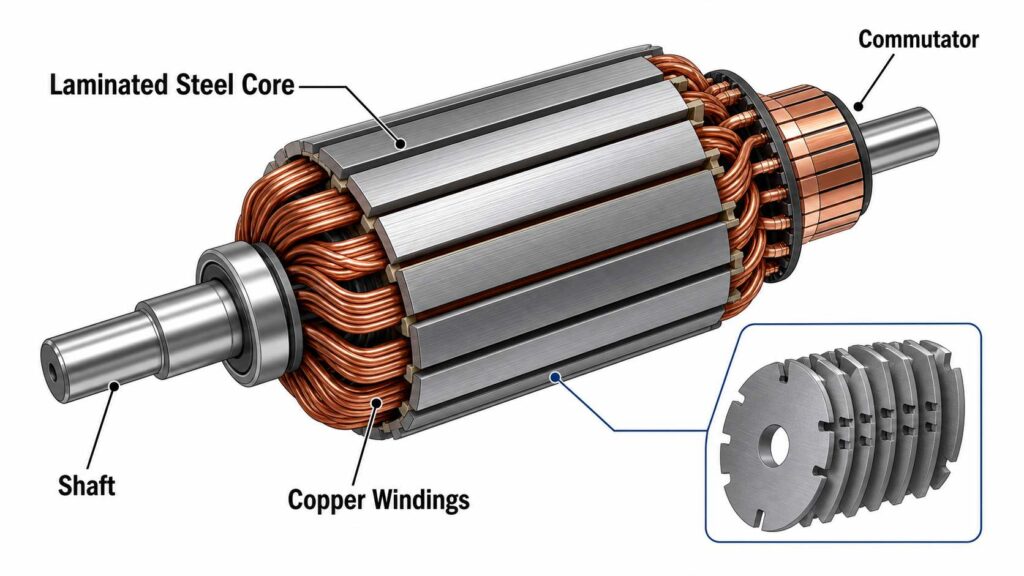
(Illustration: Iron-core armature with laminated steel core and copper windings.)
Coreless motors eliminate the traditional iron core.
Instead, the armature consists of a lightweight self-supporting winding.
Coreless motors are ideal for applications requiring rapid response and precise control.
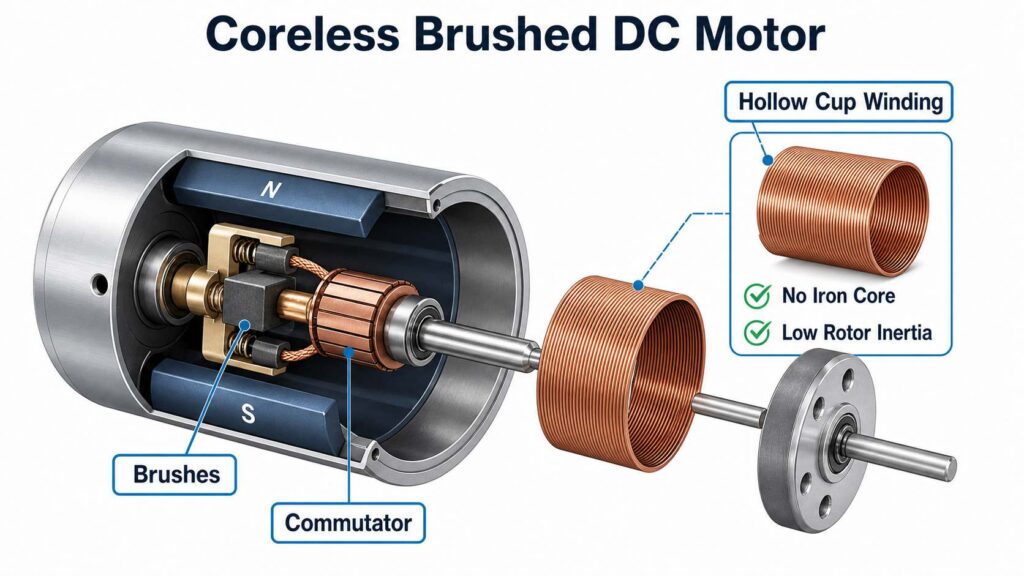
(Illustration: Coreless brushed DC motor showing the cup-shaped winding without an iron core.)
Engineering Note:
Coreless motors are available in both brushed and brushless versions. In this chapter, the discussion refers specifically to coreless brushed DC motors.
Brushed DC motors can also be classified according to how mechanical power is delivered.
These motors provide direct shaft output.
They are suitable when the required speed and torque match the motor’s natural operating characteristics.
Typical applications include:
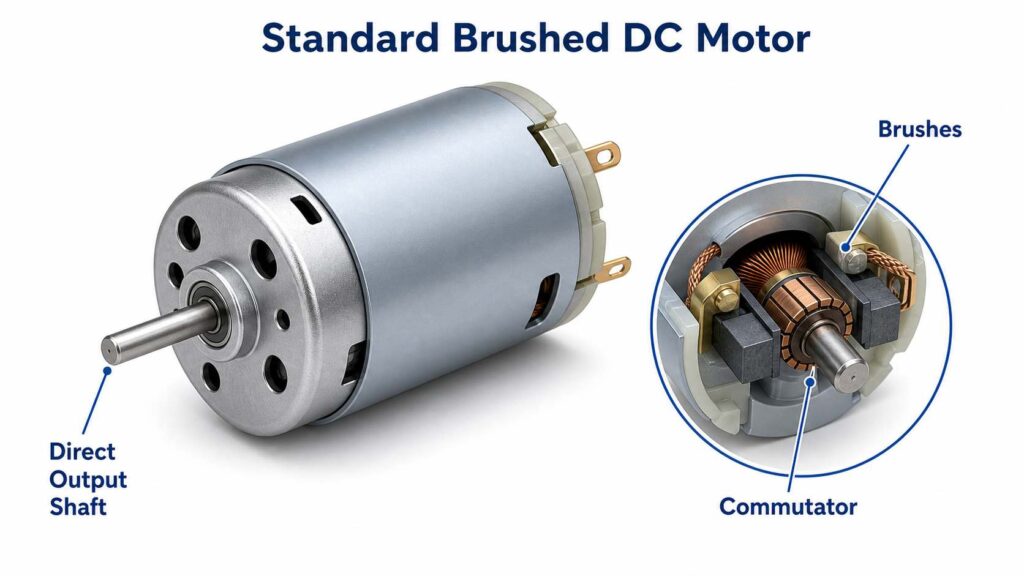
(Illustration: Standard brushed DC motor with a direct output shaft.)
A geared brushed DC motor combines a brushed motor with a gearbox.
The gearbox reduces output speed while increasing output torque.
Common gearbox types include:
Advantages include:
These motors are widely used in:
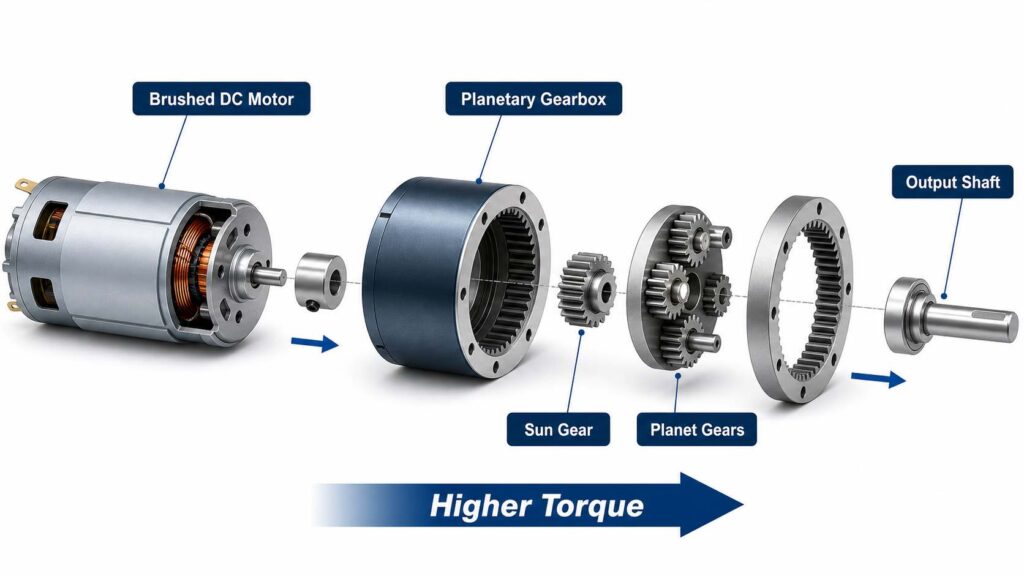
(Illustration: Exploded view of a brushed DC gear motor showing the motor connected to a planetary gearbox.)
Micro brushed DC motors are miniature motors designed for compact electronic devices.
Typical characteristics include:
Applications include:
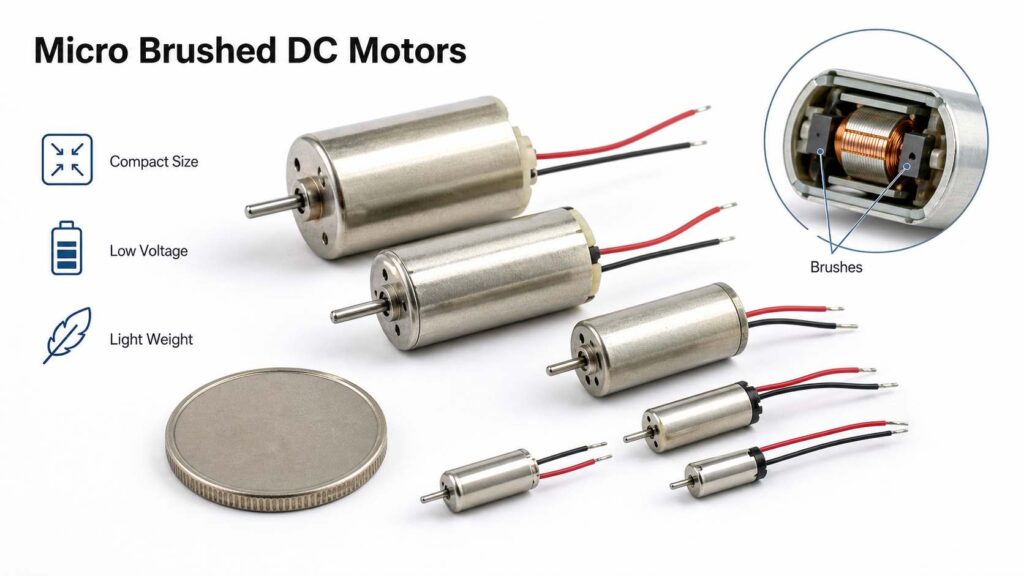
(Illustration: Various miniature brushed DC motors next to a coin for size comparison.)
Different brushed DC motor types are designed to meet different application requirements.
| Motor Type | Primary Advantage | Typical Applications |
|---|---|---|
| PMDC Motor | Compact, efficient, low cost | Consumer products, automotive |
| Series Wound Motor | Very high starting torque | Winches, starter motors |
| Shunt Wound Motor | Stable speed | Industrial machinery |
| Compound Wound Motor | Balanced torque and speed | Heavy industrial equipment |
| Coreless Motor | Fast response, low inertia | Medical devices, robotics |
| Geared Motor | High torque | Automation, actuators |
Selecting the correct motor type should always be based on the application’s speed, torque, control, and environmental requirements.
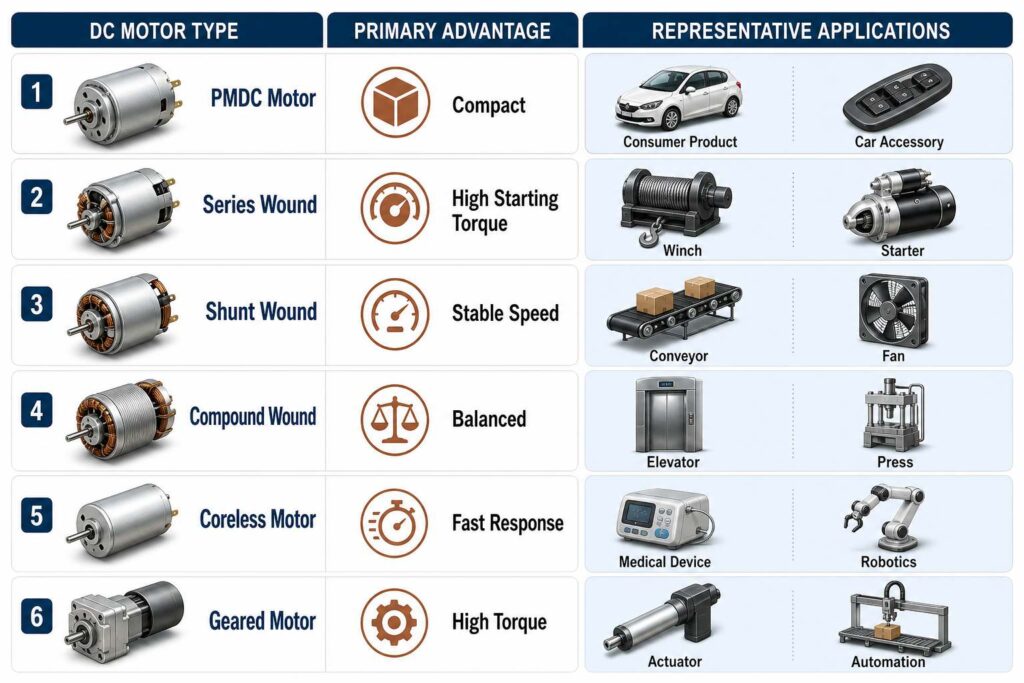
(Illustration: Comparison chart matching different motor types with representative applications.)
Many online articles incorrectly treat Permanent Magnet DC Motors (PMDCs) as if they are separate from brushed DC motors.
In reality, PMDC motors are one of the most common types of brushed DC motor. Nearly all small brushed motors used in consumer products, automotive systems, and portable devices are PMDC motors.
Similarly, coreless motors describe a rotor construction rather than a completely separate motor category. A coreless motor may be either brushed or brushless, depending on its commutation method.
Understanding these classifications helps avoid confusion when comparing motor specifications or selecting products.