Our Location
304 North Cardinal St.
Dorchester Center, MA 02124

304 North Cardinal St.
Dorchester Center, MA 02124
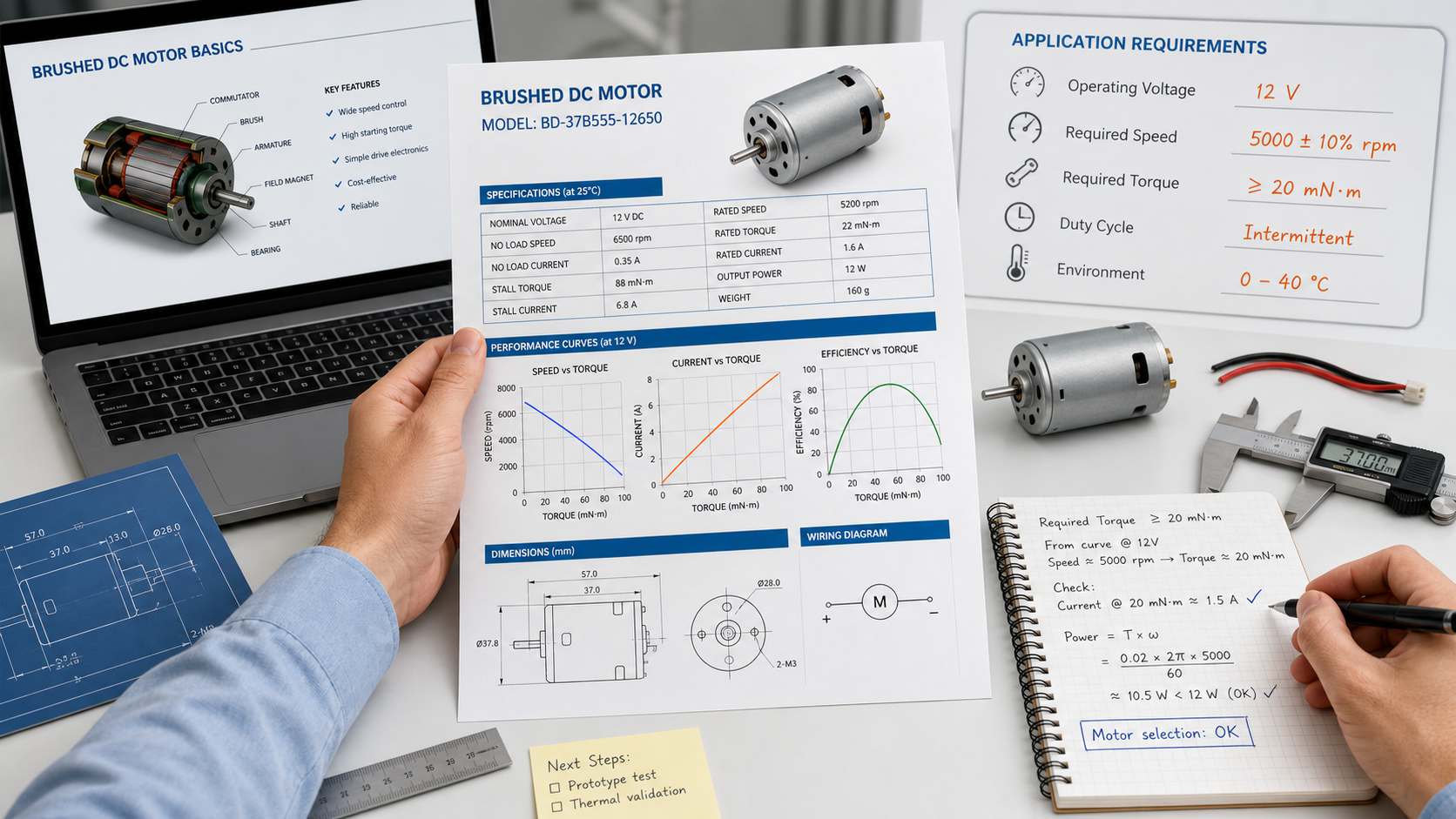
Selecting the right brushed DC motor involves much more than matching a voltage or choosing the smallest available motor.
A properly selected motor should provide sufficient torque, operate efficiently within its rated range, achieve the desired service life, and meet the environmental requirements of the application.
Choosing an undersized motor can lead to overheating, excessive brush wear, and premature failure. Conversely, selecting an oversized motor increases cost, weight, and power consumption without providing meaningful benefits.
This chapter presents a practical, engineering-oriented approach to selecting a brushed DC motor.
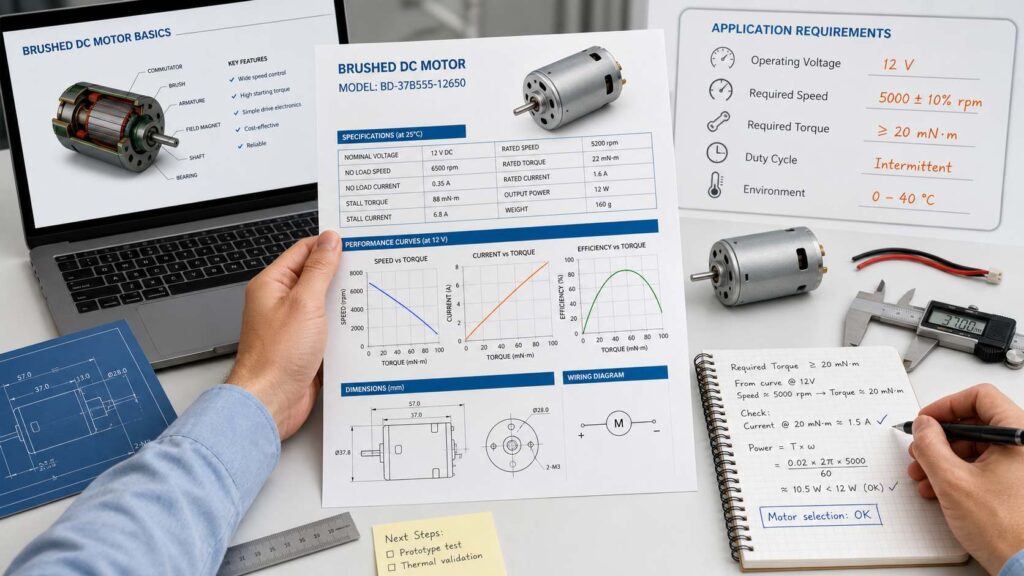
(Illustration: An engineer reviewing motor specifications alongside application requirements, with a motor datasheet and performance curves visible.)
Before comparing motor models, clearly define the application’s operating conditions.
Typical questions include:
Understanding these requirements helps eliminate unsuitable motor options early in the selection process.
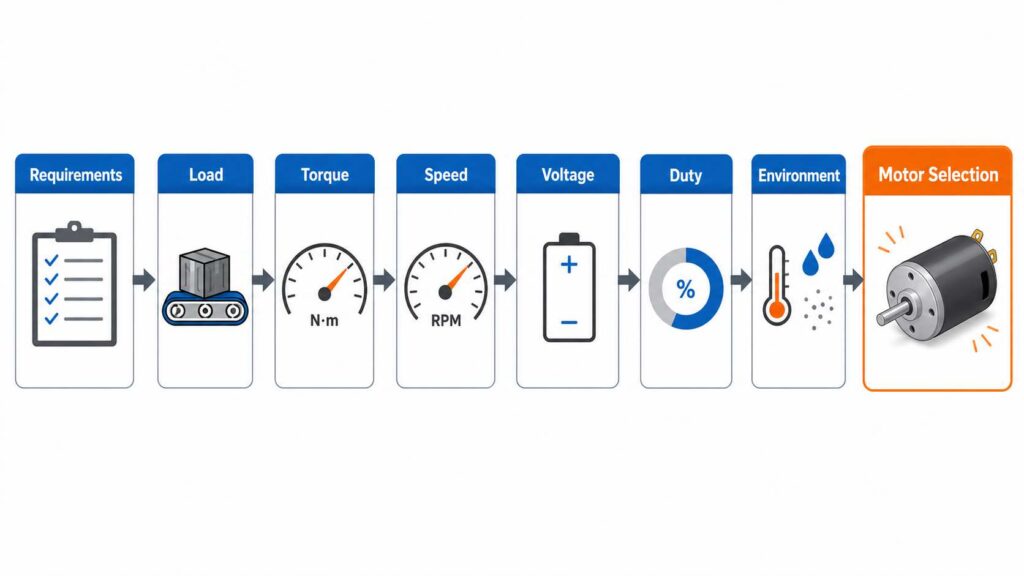
(Illustration: Flowchart showing application analysis leading to motor selection.)
Torque is usually the most important parameter when selecting a brushed DC motor.
Consider the following:
Applications with high starting loads—such as gear mechanisms, pumps, or actuators—often require significantly higher torque during startup than during normal operation.
A good engineering practice is to select a motor with sufficient reserve capacity rather than operating continuously near its maximum rated torque.
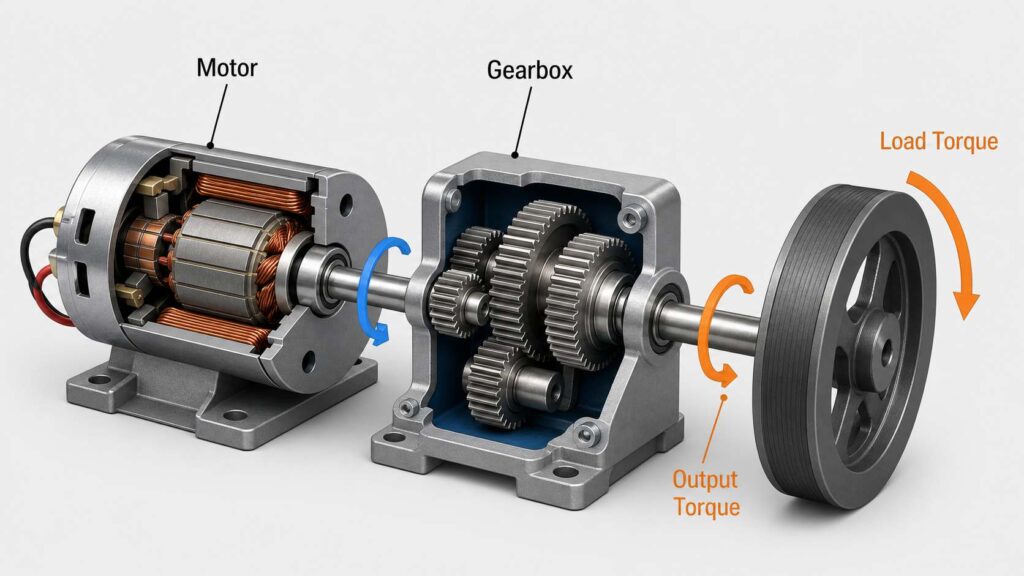
(Illustration: Example of a motor driving a gearbox with arrows indicating load torque and output torque.)
Determine the desired operating speed of the driven equipment.
Typical examples include:
| Application | Typical Speed Requirement |
|---|---|
| Cooling Fan | High speed |
| Conveyor | Moderate speed |
| Door Lock | Low speed |
| Medical Pump | Stable controlled speed |
| Power Tool | High speed with variable load |
If the required output speed is significantly lower than the motor’s natural speed, adding a gearbox may be a better solution than operating the motor at very low voltage.
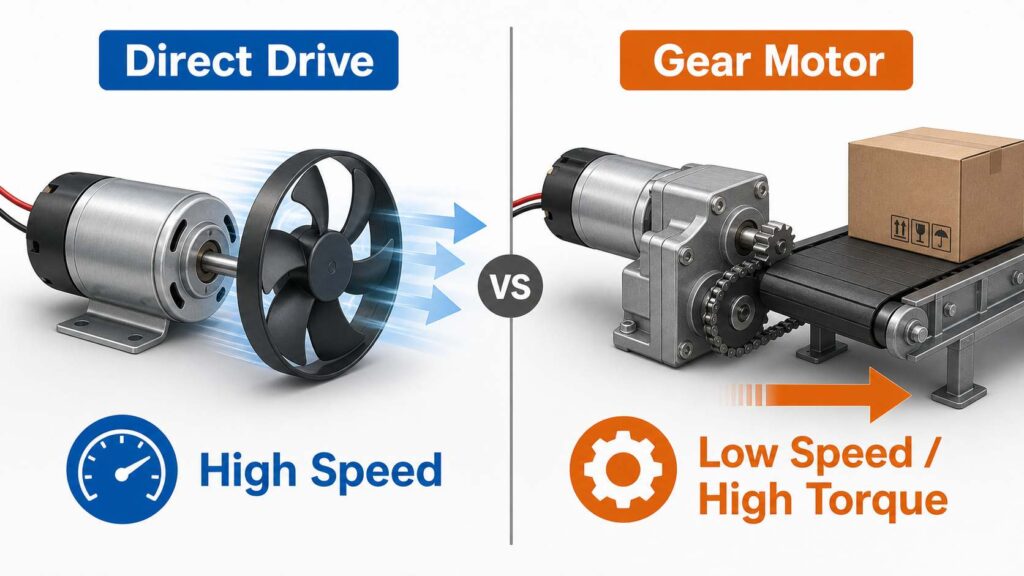
(Illustration: Comparison of direct-drive and geared motor solutions for different output speeds.)
Choose a motor whose rated voltage matches the available power supply.
Common DC supply voltages include:
Using the correct voltage simplifies system design and helps ensure predictable performance.
Avoid relying on overvoltage or undervoltage operation to achieve different speeds, as this can reduce efficiency and shorten motor life.
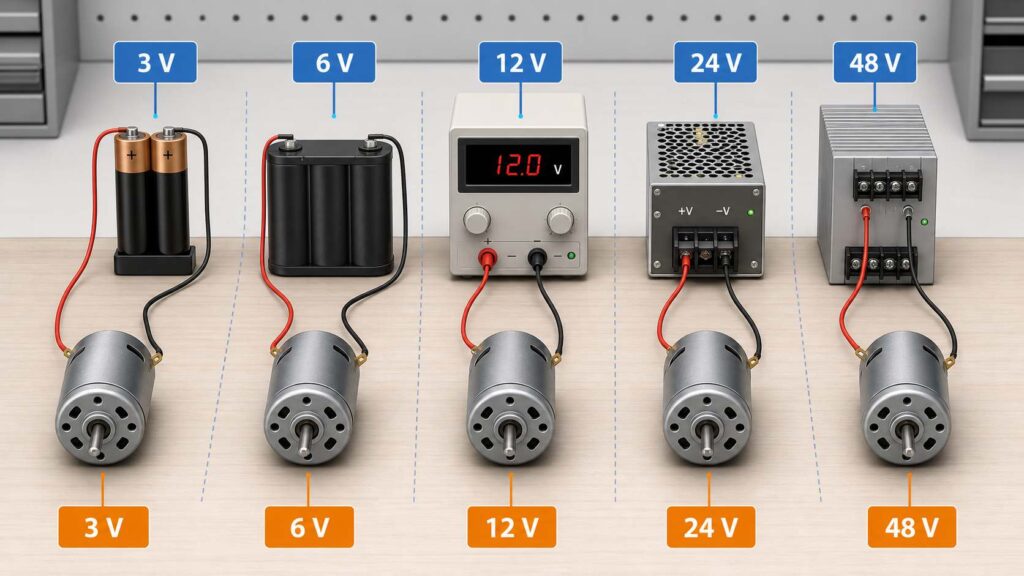
(Illustration: Various DC power sources connected to motors with matching rated voltages.)
How long will the motor operate during each cycle?
Different applications impose very different duty requirements.
Examples include:
Continuous-duty motors require effective thermal management.
Examples include:
These motors typically operate only for a few seconds before stopping, allowing time for cooling.
The expected duty cycle has a major influence on motor size, cooling requirements, and expected brush life.
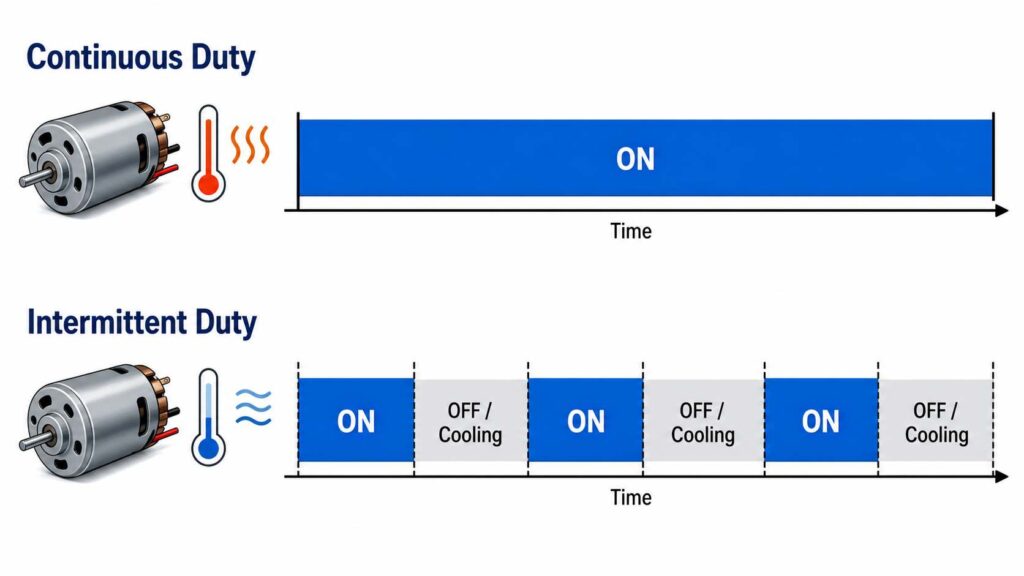
(Illustration: Timeline comparing continuous-duty and intermittent-duty operating cycles.)
Unlike brushless motors, brushed motors contain components that wear during normal operation.
Brush life depends on factors such as:
Applications that run continuously for thousands of hours may require scheduled brush replacement.
For applications where maintenance is difficult or impossible, a brushless motor may be a better long-term choice.
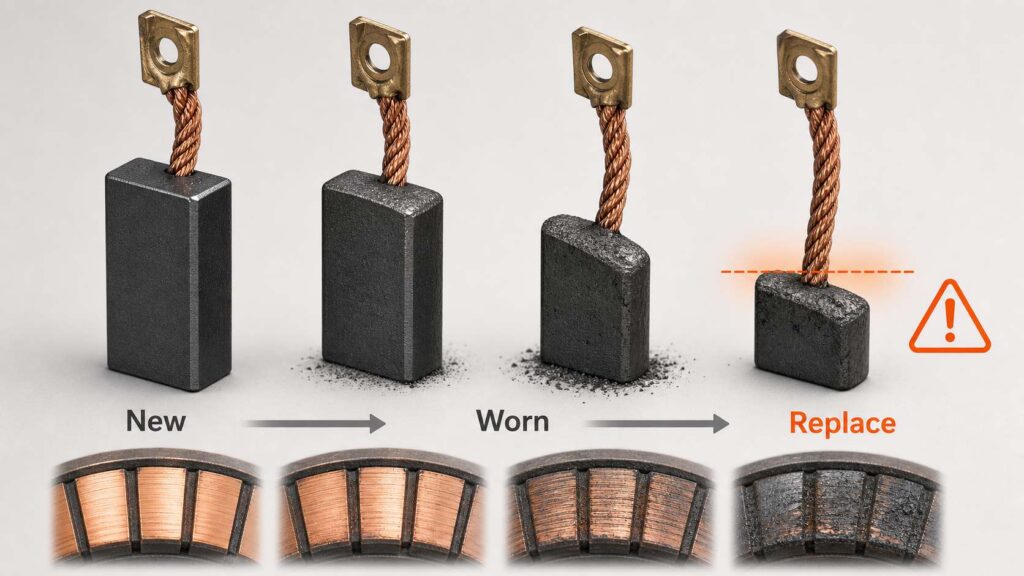
(Illustration: Carbon brush wear progression over time, from new to replacement condition.)
Environmental conditions can significantly affect motor reliability.
Consider factors such as:
High ambient temperatures reduce cooling efficiency and may shorten brush and bearing life.
Dust can accumulate around the brushes and commutator, increasing wear and reducing electrical contact quality.
Humid or wet environments may require motors with improved sealing or corrosion-resistant materials.
Applications involving continuous vibration should use motors with robust bearings and secure mounting methods.
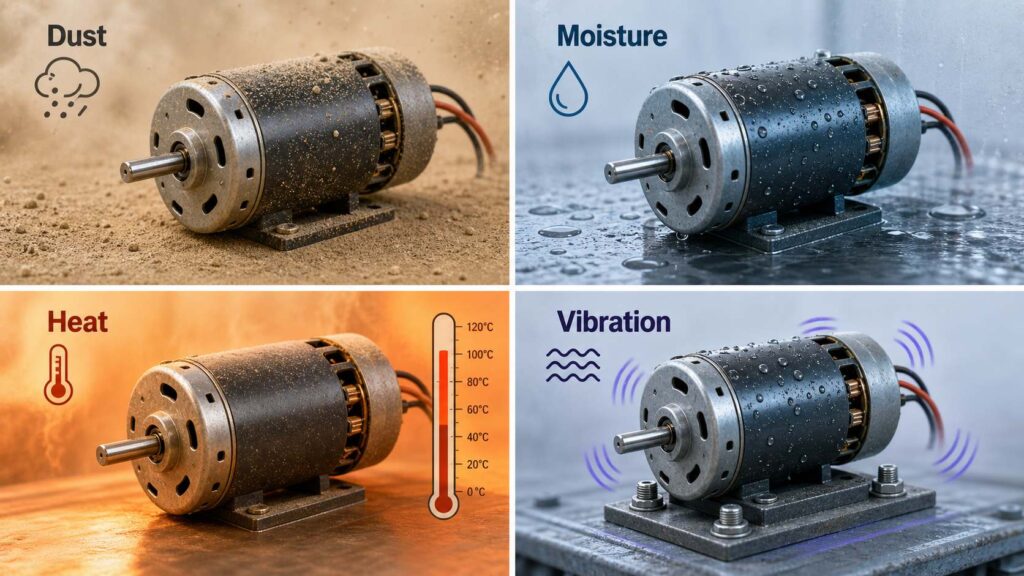
(Illustration: Brushed DC motors operating in dusty, humid, high-temperature, and vibration-prone environments.)
Many applications require high torque at relatively low output speeds.
Instead of selecting an unusually large motor, engineers often combine a brushed DC motor with a gearbox.
Common gearbox options include:
Advantages include:
However, gearboxes also introduce:
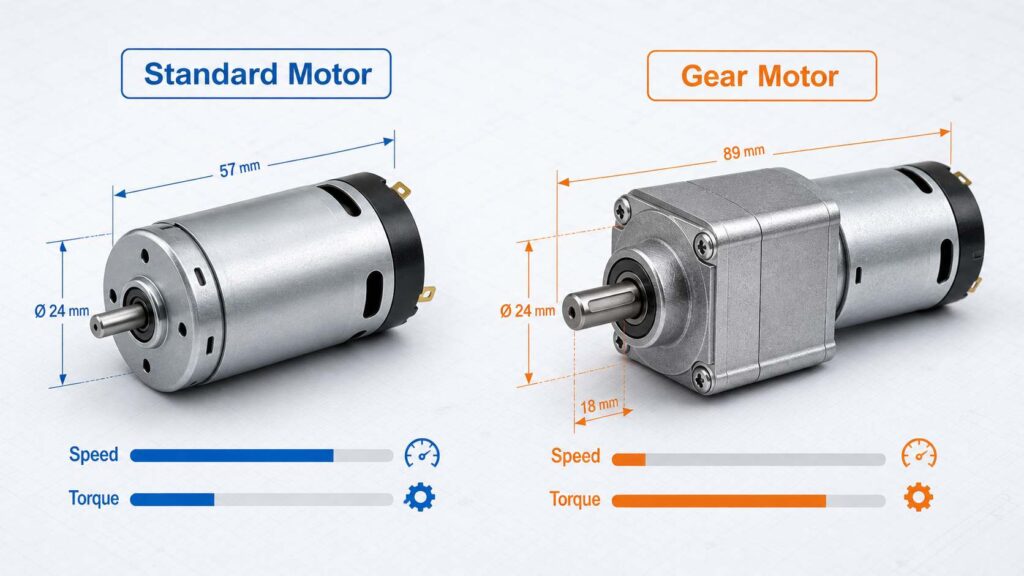
(Illustration: Comparison between a standard brushed DC motor and a brushed DC gear motor.)
Once several candidate motors have been identified, compare their datasheets carefully.
Pay particular attention to:
Avoid selecting a motor based solely on one specification, such as maximum speed or peak power.
A balanced comparison provides a much better indication of real-world performance.
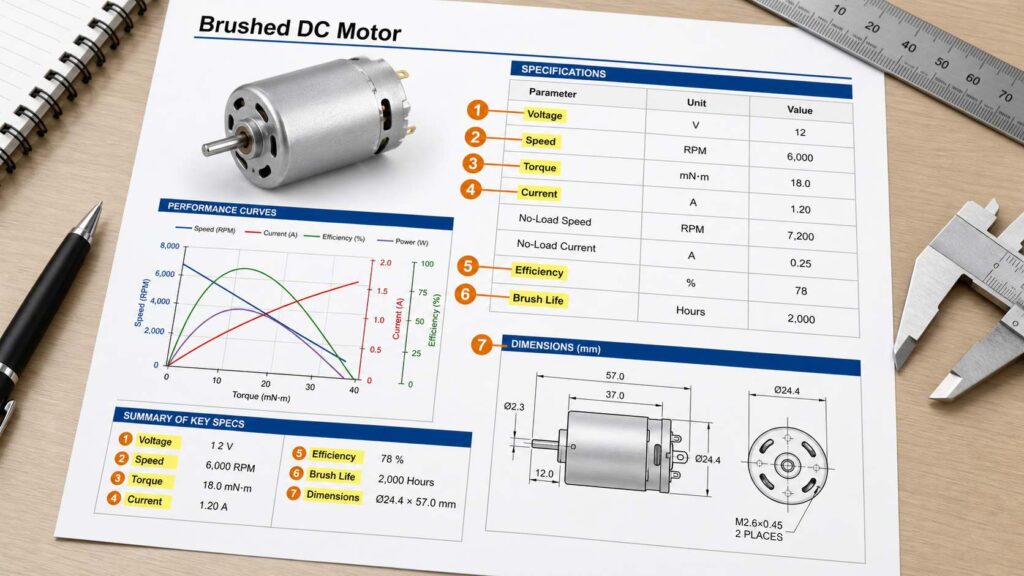
(Illustration: Example datasheet with key specifications highlighted for comparison.)
The following mistakes are frequently encountered during motor selection.
Matching the supply voltage is important, but voltage alone does not determine whether a motor can meet the required torque, speed, or duty cycle.
Some applications require much higher torque during startup than during steady operation.
If the motor cannot overcome the initial load, it may stall and draw excessive current.
Brush wear is a normal characteristic of brushed motors.
Applications requiring continuous, maintenance-free operation should consider brush life during the design stage.
Even if a motor can produce the required torque, prolonged operation beyond its thermal limits may result in overheating and premature failure.
A motor with little or no performance margin may operate continuously near its limits, reducing efficiency, shortening service life, and increasing maintenance requirements.
A reasonable safety margin generally leads to better long-term reliability.
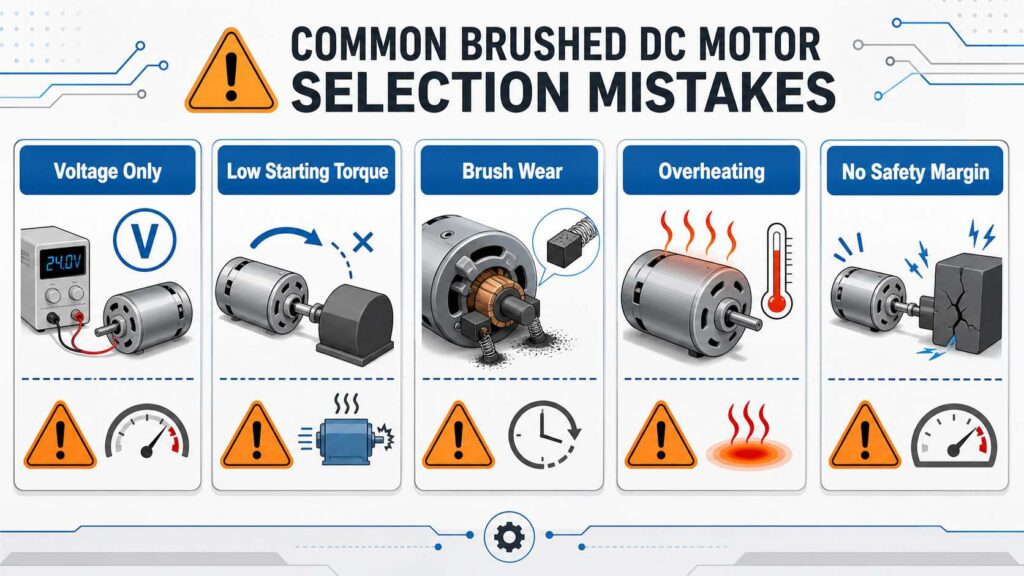
(Illustration: Infographic summarizing common motor selection mistakes and their consequences.)
Many engineers focus primarily on speed and torque when selecting a motor.
In practice, the most reliable motor selection considers the complete operating system, including:
A motor that appears ideal on paper may perform poorly if these practical factors are ignored.
Before finalizing your motor selection, verify the following:
✓ Rated voltage matches the available power supply.
✓ Rated torque exceeds the application’s continuous torque requirement.
✓ Starting torque is sufficient to overcome the initial load.
✓ Rated speed meets the application’s operating requirements.
✓ Duty cycle is compatible with the expected operating pattern.
✓ Brush life satisfies maintenance expectations.
✓ Environmental conditions are within the motor’s operating limits.
✓ Motor dimensions and shaft configuration fit the mechanical design.
✓ Bearing type is appropriate for the expected load.
✓ A suitable safety margin has been included.
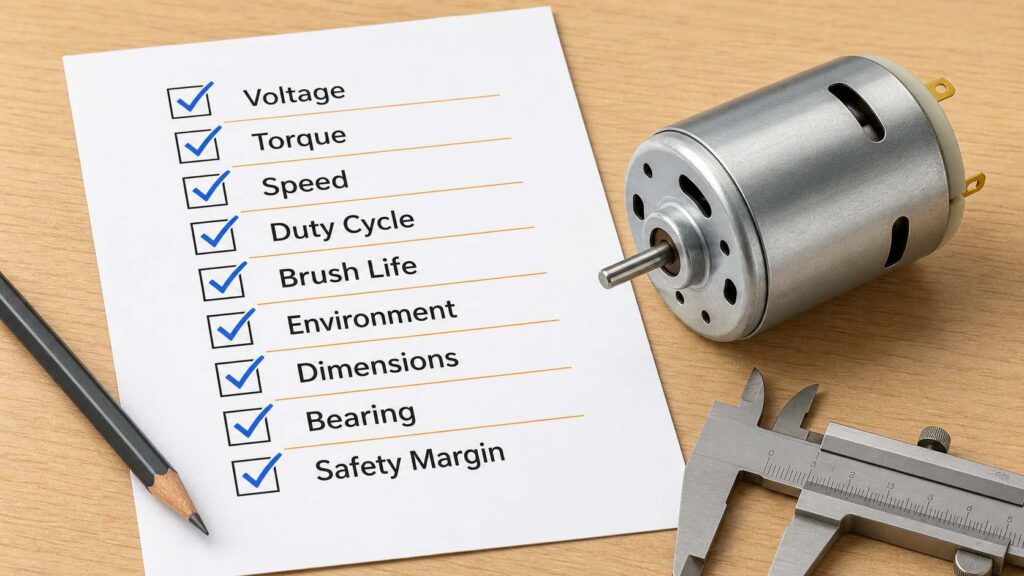
(Illustration: A printable motor selection checklist beside a brushed DC motor.)